
Battle Creek Project Status
Phase 1A (Completed)
- Wildcat Diversion Dam and Canal were removed in 2010.
- View before/after photos of Wildcat Diversion Dam removal (PDF - 1.3 MB).
- Fish screens and ladders were installed at North Battle Creek Feeder and Eagle Canyon Diversion Dams in 2010 – 2018. Facility testing, acceptance, and transfer occurred in 2019 – 2023. PG&E currently operates and monitors these fish facilities.
- A fish barrier weir was constructed on Baldwin Creek in 2013 to increase instream flow, improve anadromous habitat, and protect the upstream state trout hatchery.
- View before/after photos of the Baldwin Creek Fish Barrier Weir (PDF - 211 KB).
Phase 1B (Completed)
- Inskip Powerhouse tailrace connector and bypass pipeline to Coleman Canal were constructed in 2012 – 2015 to prevent mixing of North and South Fork waters. Facility testing occurred in 2016 – 2017 and PG&E has operated the facility since 2019.
- View before/after photos of the Inskip Powerhouse penstock bypass and tailrace connector (PDF - 1.7 MB).
PG&E’S Intent to Not Renew FERC License
In July 2018, PG&E announced it would not renew its Battle Creek Hydroelectric Project FERC license. In 2019, PG&E shared decommissioning cost estimates, prompting agency partners to evaluate alternatives and impacts on power generation, instream flows, and the Coleman National Fish Hatchery (CNFH). In March 2019, the Restoration Project partners agreed to move forward with dam removal work only.
PG&E withdrew their 2015 Phase 2 license amendment in April 2019 and submitted a removal‑only application in September 2022. Updated environmental reviews followed, including a Water Quality Certification (February 2024), a Biological Opinion (October 2024; amended January 2025), and an Environmental Assessment (April 2025). FERC approved the revised Phase 2 license amendment on May 21, 2025.
Phase 2 (In Progress)
South Dam and Canal Removal Contract
- Includes removal of South Diversion Dam, South Canal, Soap Creek Feeder Dam, and Lower Ripley Creek Feeder Dam.
- Awarded to Forgen, LLC in late 2025; full mobilization began June 2026. Completion is expected in December 2026.
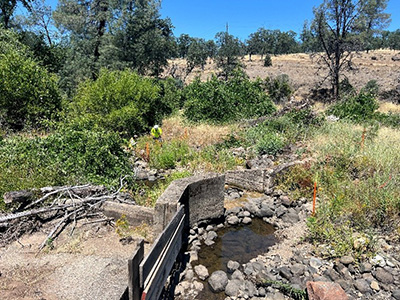
Prior to removal, looking from the upstream side.
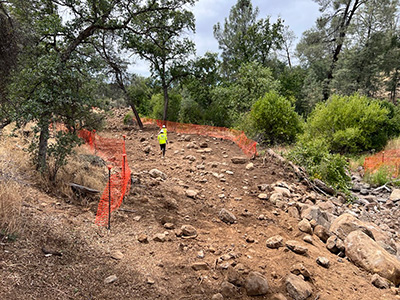
Looking downstream in the filled canal restored.
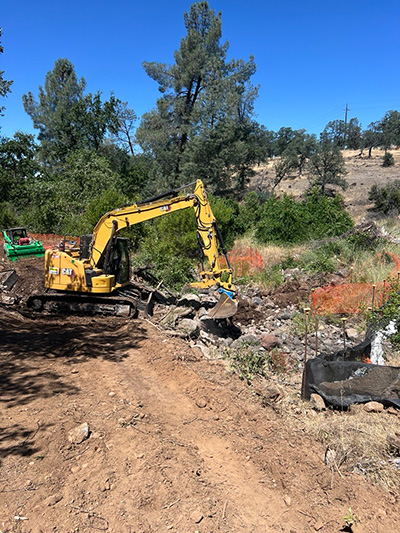
Removal looking downstream.
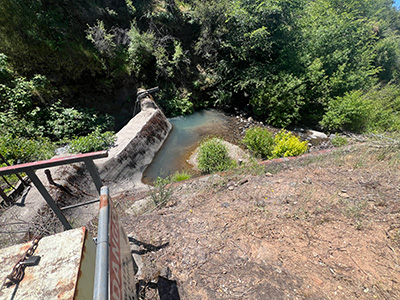
Prior to removal, looking from the right bank.
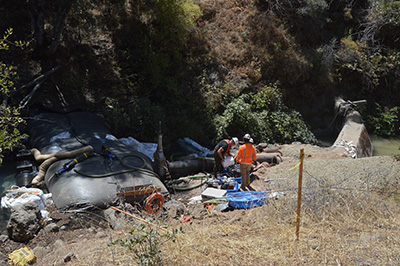
Cofferdam installation, looking from the right bank.
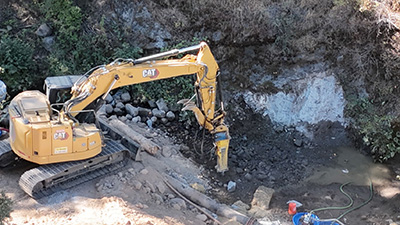
Dam removal using a hydraulic hoe ram, looking from the right bank.
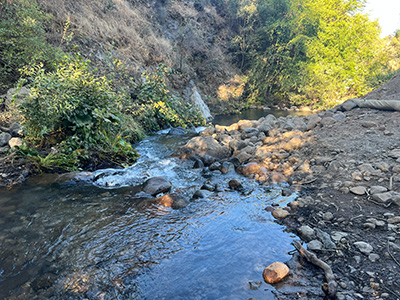
Dam removed and the creek restored, looking downstream from the right bank.
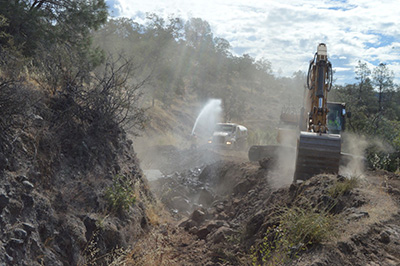
Crew preparing to backfill the canal, looking upstream.
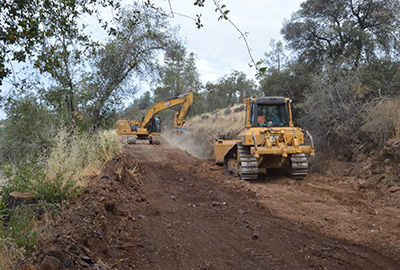
Crew backfilling the canal, looking downstream.
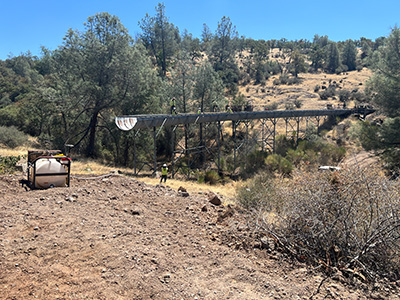
Preparation of Flume #9 removal.
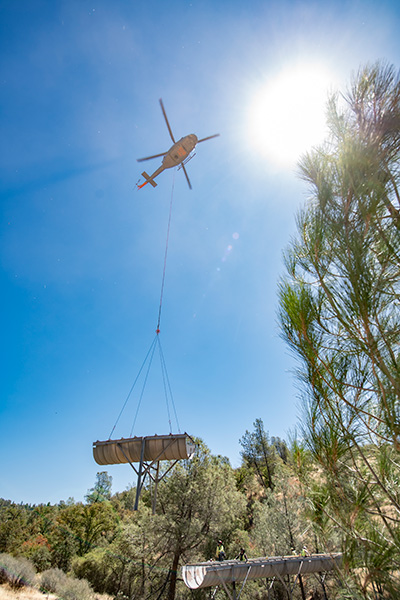
Section of Flume #9 airlifted with helicopter.
Coleman Dam Removal Contract
- Final design was completed in January 2024.
- Procurement may occur as soon as 2028 with construction planned for 2029. Timeline is contingent on CNFH water supply and modernization projects.
- In September 2025, Reclamation’s Northern California Area Office (NCAO) indicated that the construction funding request for CNFH modernization is unlikely to be approved. NCAO and USFWS are exploring all funding options and strategizing how best to utilize the $20M already received.
Hydropower Facilities Modifications – Stage 2, Part 1
- Included a South Powerhouse tailrace tunnel and access road to Inskip Diversion Dam.
- Final design was completed in 2018; construction was not pursued following PG&E’s decision to surrender the FERC license.
Hydropower Facilities Modifications – Stage 2, Part 2
- Included fish screen and ladder at Inskip Diversion Dam.
- Final design and construction were not pursued.
- PG&E removed Inskip Diversion Dam in 2025.
Battle Creek Hydroelectric Project Decommission
PG&E formally decided not to seek a new FERC license in 2020. FERC issued a notice in 2021 to identify potential new operators and received no interest. In late 2022, FERC directed PG&E to prepare a license surrender plan.
PG&E is now developing the License Surrender Application. FERC must approve the application before decommissioning can begin. This effort is separate from the Restoration Project. Visit the Battle Creek Hydroelectric Project decommission page for more information.
Adaptive Management
Processes to ensure fisheries objectives and goals are met and will be implemented beyond Restoration Project construction completion.
Restoration Project Adaptive Management. The Restoration Project Adaptive Management Plan (AMP) (PDF - 2.2 MB) was completed in 2004. Its goal is to implement specific actions to protect, restore, enhance, and monitor salmonid habitat associated with the Battle Creek Hydroelectric Project within the Restoration Project area to guard against false attraction of adult migrants, and ensure that Chinook salmon and steelhead are able to fully access and utilize available habitat in a manner that benefits all life stages and thereby maximizes natural productions, fully utilizing ecosystem carrying capacity.
Coleman National Fish Hatchery (CNFH) Adaptive Management. CNFH is located downstream of the Restoration Project area on the main stem of Battle Creek. CNFH is funded by Reclamation, owned and operated by the USFWS, and guided by USFWS policy and other state and federal laws. The CNFH AMP (PDF - 8.3 MB), completed in November 2016, includes solutions and processes to support CNFH programs, operations and infrastructure so that hatchery mitigation goals and objectives are achieved and there is compatibility with the Restoration Project.
Integrated Adaptive Management in Battle Creek. The Restoration Project 1999 MOU Partners; Reclamation, USFWS, NMFS, CDFW, and PG&E are committed to coordinating CNFH and Restoration Project AMP efforts. This commitment is memorialized in the Memorandum of Understanding Regarding Integrated Adaptive Management of the Battle Creek Salmon and Steelhead Restoration Project and Coleman National Fish Hatchery, signed by the Project Partners in November 2016 and included (as an appendix) in the CNFH AMP.
The Restoration Project adaptive management effort was formally launched in late 2024, with the first BCRP Adaptive Management Annual Report released in September 2025. In 2026, efforts focus on integrating the BCRP and CNFH Adaptive Management Technical Teams while continuing regular stakeholder engagement.
Note: Documents in Portable Document Format (PDF) require Adobe Acrobat Reader 5.0 or higher to view, download Adobe Acrobat Reader