
Hadrosaurs Tracks
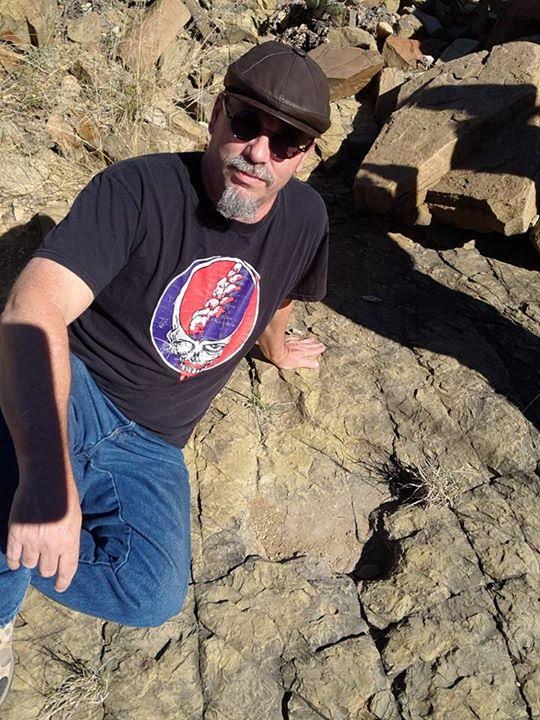
While hiking on Reclamation land around Elephant Butte a month or so ago, a local resident found what appeared to be dinosaur footprints near an arroyo.
Albuquerque Area Office archaeologist Mark Hungerford and Dr. Spencer Lucas, the Curator of Paleontology at the New Mexico Museum of Science and History, recently traveled down to assess the find. They identified the tracks as being made by two individual Hadrosaurs about two meters (or 6½ feet) high, walking in opposite directions.
Hadrosaurs were bipedal herbivores, also known as “duck-billed” dinosaurs. Interestingly, paleontologists speculate that Hadrosaurs had a unique hinge between the upper jaw and the skull, unlike that of any current species.
The tracks were created in sandy soil, during the Cretaceous Period, approximately 80 million years ago. The footprints would have been made in sand, and then gently buried by the next deposition of rock. The arroyo had to erode at just the right level to expose them. At that time, most of the state was covered by an inland sea, known at the Museum of Natural History as the New Mexico Seacoast. The footprints were found in strata known as the Crevasse Canyon Formation. This is the first set of dinosaur footprints found in Sierra County, but Dr. Lucas and Mark Hungerford believe that there are more footprints to be found in the area.
