
- Reclamation
- CPN Region
- Environmental Documents
- Scoggins Safety of Dams
Scoggins Dam: Safety of Dams Modification Project
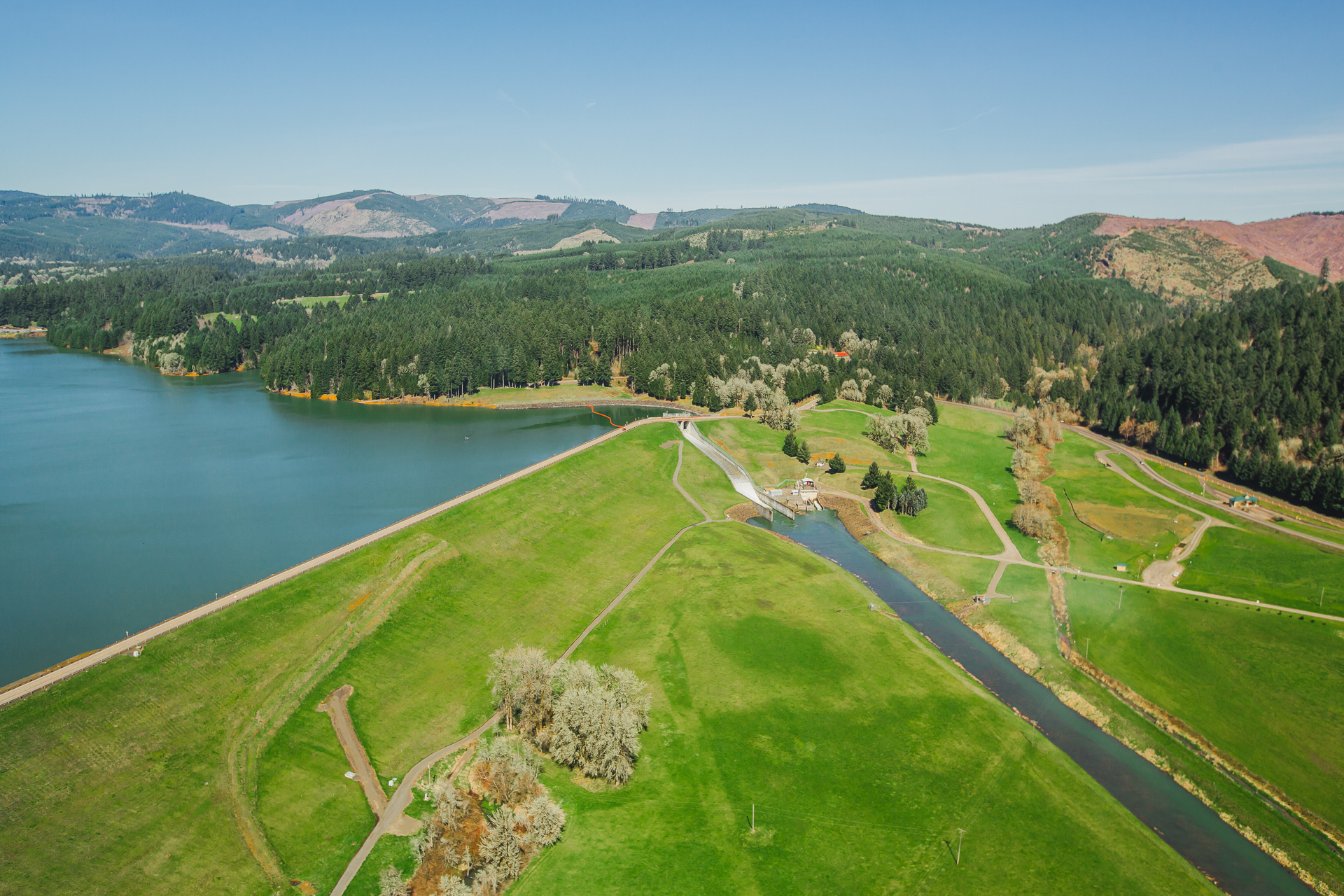
Scoggins Dam, located near Gaston in Washington County, Oregon, is part of the Tualatin Project. Under Reclamation’s Safety of Dams program, Dams must be operated and maintained in a safe manner, ensured through inspections for safety deficiencies, analyses utilizing current technologies, and corrective actions if needed based on current engineering practices. As part of this program, Scoggins Dam is inspected annually to meet Reclamation safety and operation and maintenance requirements.
Seismic deficiencies were first identified in 2003, prompting studies and evaluations of corrective actions. In 2025, Reclamation leadership directed a new corrective action study to focus on strengthening the critical vulnerability of the dam’s spillway under seismic loading. Utilizing results from the study, Reclamation is developing design solutions to materially improve dam safety and reduce risk to downstream communities.
Project Status
In 2026, the Scoggins Safety of Dams Modification Project shifted its primary focus to the critical renovation of the spillway, a necessary step to ensure long-term dam safety, regulatory compliance, and reliable water supply for the region.
The Bureau of Reclamation will begin studying and developing a revised alternative solution and design study that specifically targets and strengthens the dam’s spillway, which has been determined to be a critical seismic vulnerability.
The Safety of Dams program focuses on evaluating and implementing actions to resolve safety concerns at Reclamation dams. Under this program, Reclamation evaluates dam performance during large earthquakes to assess the associated public safety risks. The selected course of action relies on assessments of threats and consequences with environmental considerations and public input to the decision-making process. Reclamation remains committed to increasing facility reliability and improving safety for downstream communities in the event of an earthquake.
2026 Scoggins Safety of Dams Project Process Flowchart

Frequently Asked Questions
1. When was Scoggins dam built?
Built between 1972 and 1975, Scoggins Dam is a 151-foot-high, zoned earth-fill structure that is 2,700 feet long at the crest and contains over 4 million cubic yards of material. The upstream side of the dam is covered with rock material to protect against wave action; the downstream side is faced with topsoil and planted with grass. Total capacity of its reservoir, Henry Hagg Lake, is 59,910 acre-feet.
2. Why wasn’t the dam designed for earthquakes in the first place?
The design and construction did not include modern-day seismic design, which became more common after its construction. Little was known at the time about the potential hazard earthquakes can pose to dams. Research carried out since the 1970s has greatly increased knowledge about potential impacts from earthquakes. Understanding of the regional geology and the potential magnitude of earthquakes also has increased.
3. Will future Safety of Dam work impact reservoir water levels?
During construction, Henry Haag Lake will be managed within its current operating range of elevation. Efforts will be made to limit impact on water deliveries or water-based recreation activities. Water supply reliability and public safety remain the top priorities throughout planning and construction.
4. Why has there been a change in scope for construction modifications and why focus on the spillway?
The original plan was paused because of cost effectiveness, constructability, and priority concerns. The spillway is a critical safety component, so we are focusing remediation efforts there first. This shift represents a strategic prioritization to address the most urgent safety component.
5. Will the Environmental Impact Statement initiated in January 2024 for the former dam safety modification proposal still be published?
No - the EIS effort was cancelled due to the change in scope for construction modifications. Following developing a revised alternative solution, a new environmental review under National Environmental Policy Act will be initiated.
6. When will the new project start?
As of July 2026, Reclamation is in the planning stages. Construction work will begin after scoping, design, and approvals are completed. The public and stakeholders will have opportunities to participate and provide input through planned in person/virtual meetings and through the NEPA environmental review process.
7. What is the projected cost of the new project?
The revised plan is expected to be more cost-effective than the original. Preliminary cost estimates are still being refined.
8. What will happen to Scoggins Dam if a seismic event occurs?
Scoggins is an earthen embankment dam that can withstand frequent seismic events by deforming rather than failing. Reclamation will continue to monitor the performance of Scoggins Dam and to assess the seismic risks.
9. Why does this process take so long?
The process to verify the need for dam modifications is very extensive. Reclamation follows a rigorous process of investigation and evaluation to provide high confidence in our analysis and to ensure Reclamation designs and constructs the most appropriate modifications for a dam.
10. How long will construction take?
The length of time for construction will vary depending on the selected design to modify the spillway.
11. Is a reservoir restriction being implemented?
A reservoir restriction will be considered as an option in the current effort because that is a requirement for dam safety evaluations. In the previous effort, a reservoir restriction was significantly more economical than any of the construction alternatives. The objective of the SOD modification project is to develop an alternative that will reduce dam safety risk while maintaining levels of authorized project benefits.
Upcoming Meetings & Events
| Date | Meeting or event |
|---|---|
News Releases & Public Notices
| Date | Topic |
|---|---|
Project Documents & Environmental Reviews
| Date | Title |
|---|---|
Contacts
Keenan Arnold, dam safety coordinator
208-378-5256, karnold@usbr.gov
Bureau of Reclamation, Columbia–Pacific Northwest Region
1150 N Curtis Road, Boise, Idaho 83706-1234
Jason Sutter, natural resource specialist
jasutter@usbr.gov
Bureau of Reclamation, Columbia–Pacific Northwest Region
1150 N Curtis Road, Boise, Idaho 83706-1234
Tara Jane Campbell Miranda, public affairs specialist
tarajane_campbellmiranda@ios.doi.gov
Department of the Interior, Office of Communications
