


Upper Colorado Basin Region’s Adaptive Management and Water Quality Division projects plan to make an impact
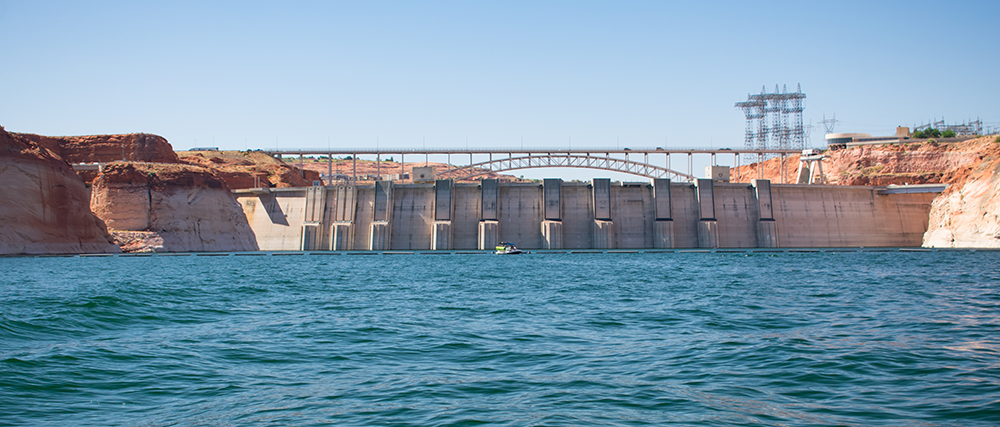 Glen Canyon Dam forebay
The UCB Adaptive Management and Water Quality Division is having a busy spring, and multiple recently funded research projects focused on water quality management, forecasting, groundwater research, and fish species management in the Colorado River Basin area will certainly keep the work flowing strong.“ We’re extremely pleased to see so many innovative projects receive funding this year because the future management of the Colorado River will depend on our ability to continuously adapt, improve our understanding of the system, and make informed decisions using high-quality data,” said Bill Stewart, acting manager of the Upper Colorado Basin Region Adaptive Management and Water Quality Division. “These projects represent important investments in new technology, forecasting, monitoring, and research that will help us better respond to changing conditions across the Basin while supporting reliable water management for the future.”
Civil Engineer Bryce Mihalevich is leading a project for a real-time water quality dashboard for Lake Powell. This $400k WaterSMART project installs a floating water quality monitoring platform in Glen Canyon's forebay where it will autonomously collect water quality information (e.g., temperature, specific conductivity, dissolved oxygen, turbidity, and chlorophyll) at depths between 0- and 100-meters multiple times per day. Given that this information has been historically measured on a monthly interval, this system significantly improves the temporal resolution of water quality data and will lead to better estimates of the quality of water released from Glen Canyon. Additionally, this platform provides monitoring for potential algal blooms, an emerging issue on Lake Powell. Data from this platform will be delivered in real-time to stakeholders through a public facing internet dashboard.
A second project Mihalevich is leading builds off the WaterSMART project to improve water quality forecasting and forecast reporting. This near-term water quality forecasting system is receiving approximately $500k in Science and Technology Research Program funds through Reclamation’s Research and Development Office for the development of an autonomous water quality forecasting system using equipment and data from the forebay water quality monitoring platform mentioned above. It includes the development of models that will generate daily water quality forecasts that project out 30 days into the future. Forecasts will be integrated into the data dashboard, improving stakeholder accessibility. These two related projects are currently in the planning phase, with hopes of having the equipment in place this fall.
“At the monthly sampling interval we miss changes in water quality, especially due to spring inflows and weather events, which makes estimating the quality of water being released challenging. Having more frequent depth-resolved data collection allows us to better understand changing conditions in Lake Powell and make more informed water management decisions,” said Mihalevich. “As reservoirs across the Colorado River Basin continue to be stressed by poor hydrology, observing and reporting water quality changes is becoming increasingly important.”
Biologist Jeremy Hammen with the Upper Colorado Basin Region Adaptive Management Group is also leading a Science and Technology Research Program project with the National Park Service for long-term landscape-level springs monitoring and groundwater research in the Grand Canyon. This $450,000 project over three years focuses on monitoring springs in the Grand Canyon to quantify groundwater contributions, assess spring health, and analyze water quality trends using remote sensing, continuous gauges, and seasonal sampling to support water resource management. The research aims to address two primary objectives: (1) to quantify groundwater contributions to the Colorado River and analyze long term-trends in response to rising temperatures and altered precipitation patterns; and (2) to conduct a comprehensive assessment of spring health and water quality, which will serve as baseline data for determining trends in spring health and will inform water management strategies and enhance drought resilience. The project will include seasonal water quality sampling to better understand groundwater vulnerabilities and establish baseline hydrological data starting this summer. The information collected will support collaborative water management efforts and help advance the Bureau of Reclamation’s goals for water reliability, resilience, and conservation in the Lower Colorado River Basin.

“Working closely with the National Park Service allows us to combine expertise and resources to better understand how groundwater and springs contribute to the Colorado River system,” said Hammen. “Groundwater is an important piece of the Basin’s overall water picture, but there are still gaps in our understanding of how these systems respond to drought, changing precipitation patterns, and rising temperatures. By collecting long-term data on spring health and groundwater contributions, we can help improve water management decisions and better prepare for future changes across the Basin.”
And if you think asking Copilot to summarize your inbox is innovative and useful technology, this next project might blow your mind. Biologist Kerri Pedersen and Matt O’Neill with the Upper Colorado Basin Region Adaptive Management Group are working on an automated smart trap for fish management. Using a $425k investment also funded by the Science and Technology Research Program, this project will develop an image library of Colorado River Basin fishes, use the image library to train the AI system to distinguish native and non-native species, refine existing designs and construct experimental smart-trap systems for field testing. These smart traps will be field-tested in various locations in the Grand Canyon and the San Juan River. This project has the potential to increase efficiency because it can remain in place for longer periods of time without requiring a person to empty the trap, as well as minimize any harm to native and sport fishes since the trap will identify and not capture them. Once contracting is complete, the project team will begin to capture images to train the AI model and hope to construct the traps and deploy them for testing in 2028.
“We’re excited about the potential for this project to add a new tool to the toolbox for addressing issues with non-native fish,” said Pedersen. “By using AI to identify and selectively retain specific species, we hope to improve efficiency in the field while reducing handling stress and unintended impacts on native fish populations.”
Together, these projects highlight the Upper Colorado Basin Region Adaptive Management and Water Quality Division’s commitment to using science, technology, and innovation to address complex water and environmental challenges across the Colorado River Basin. As the projects move from planning to implementation, the research and data they generate will support Reclamation’s mission to protect water resources, ecosystems, and communities throughout the Basin. We’ll be paying attention as these projects continue to develop in the coming months!
