


Reclamation’s annual operating plans for the Rio Grande and Pecos River reflect poor hydrology
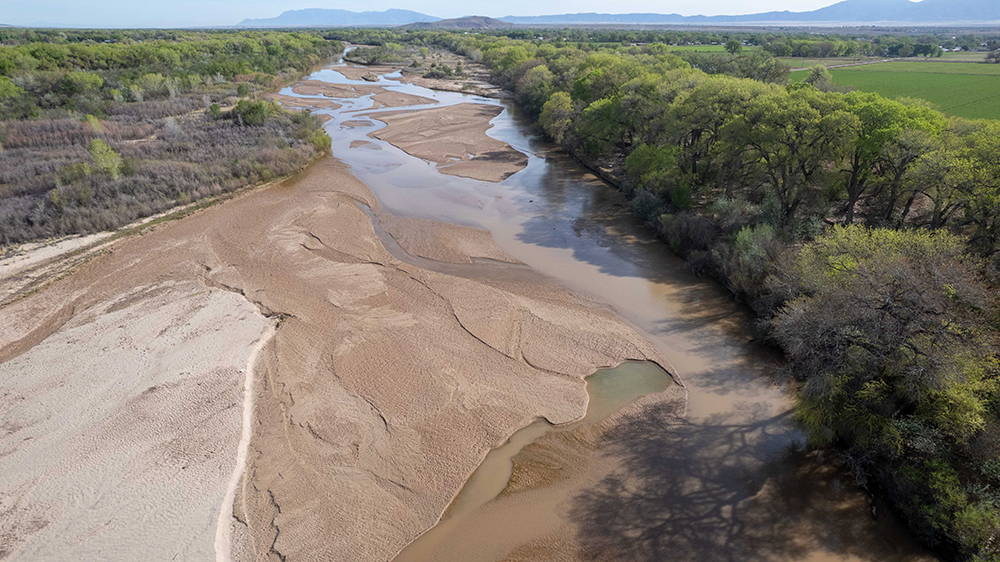 Diminishing flows in the Rio Grande Isleta reach April 9, 2026. Photo by GeoSystems Analysis
ALBUQUERQUE, N.M. — Water managers on the Rio Grande in New Mexico are bracing for drought conditions created by the earliest snowmelt on record, one of the lowest snowpacks on record and already low reservoir storage. The Bureau of Reclamation’s annual operating plans for the Rio Grande and Pecos River reflect the poor hydrology.
“Being faced with a third dry year in a row is a big challenge,” said Albuquerque Area Office Acting Area Manager John Irizarry. “We have had many years to prepare during this third decade of extended drought, and I am confident our team will work closely with all stakeholders to make the available water supply stretch as far as possible.”
The runoff of one of the lowest snowpacks on record has already peaked. Predictions are for hot, dry conditions through May, but the National Weather Service is showing a change to above average precipitation during the summer monsoon season.
Most reservoirs along the Rio Chama and Rio Grande are holding less than 15% of their capacity, which means there is little water in storage to supplement what will flow through the rivers for irrigation, municipalities, recreation, and endangered species. Heron Reservoir sits at 11%, El Vado Reservoir at 13% and Elephant Butte Reservoir at 13% of capacity.
As of mid-April, snow water equivalent was 4% of median for the Rio Chama Basin, 13% of median for the Rio Grande headwaters, 21% of median for the Sangre de Cristos, and snow in the Jemez had melted out. The Natural Resources Conservation Service’s April streamflow forecast predicts the Rio Chama flow into El Vado Reservoir will be 24% of average, with an inflow of about 40,000 acre-feet of water.

Construction at El Vado Dam under Reclamation’s Dam Safety Program is on hold and the reservoir is currently restricted to approximately 13% of capacity, which is about 25,200 acre-feet. Efforts to develop and implement a long-term solution for the dam are ongoing. Restrictions under the Rio Grande Compact also currently limit storage in El Vado.
If monsoon rains do not materialize, Elephant Butte Reservoir could be at about 2% of its capacity by late August, slightly below lows experienced in 2013. In 2025, the reservoir fell to 3% of full.
On the Pecos River, basin-wide snow water equivalent was 0% of median on March 31, and the Natural Resources Conservation Service predicted 9,000 acre-feet of inflow to Santa Rosa Reservoir from March to July. However, that snowpack has already melted, and none of it reached Santa Rosa Reservoir. Any additional water coming into the reservoir would come from rainstorms.

Information from Annual Operating Plans:
- The Middle Rio Grande Conservancy District began staggered irrigation operations in late March with natural flow of the Rio Grande.
- Irrigation diversions in Colorado began earlier than usual, in mid-March.
- Due to the expected low runoff, lack of water in storage, and a minimal supply of water for Reclamation to lease to supplement river flows, parts of the Rio Grande flowing through Albuquerque could experience drying this summer.
- Drying began in the San Acacia reach on March 27, which is the earliest recorded date it has dried in the past three decades.
- Reclamation is coordinating with the U.S. Fish and Wildlife Service to rescue endangered fish from drying portions of the river and coordinating with partners to use the limited supply of water most effectively.
- Available storage in Elephant Butte and Caballo reservoirs for the Rio Grande Project is currently about 265,000 acre-feet.
- Irrigation releases are scheduled to begin from Elephant Butte Reservoir around 8 a.m. on April 28 and from Caballo Reservoir on May 29. The dry riverbed below both Elephant Butte and Caballo dams will take on water quickly. As such, these areas will be both unpredictable and dangerous and the public is asked to exercise caution around the river channel. Water levels will fluctuate through the rest of the short irrigation season.
- On the Pecos River, the Carlsbad Irrigation District began releases for irrigation on March 22 and has allocated 2.5 acre-feet per acre to farmers.
Those who could not attend the Annual Operating Plan meetings will be able to view the presentation on Reclamation’s website. For more information on Albuquerque area water operations, visit Albuquerque Water Operations.
