


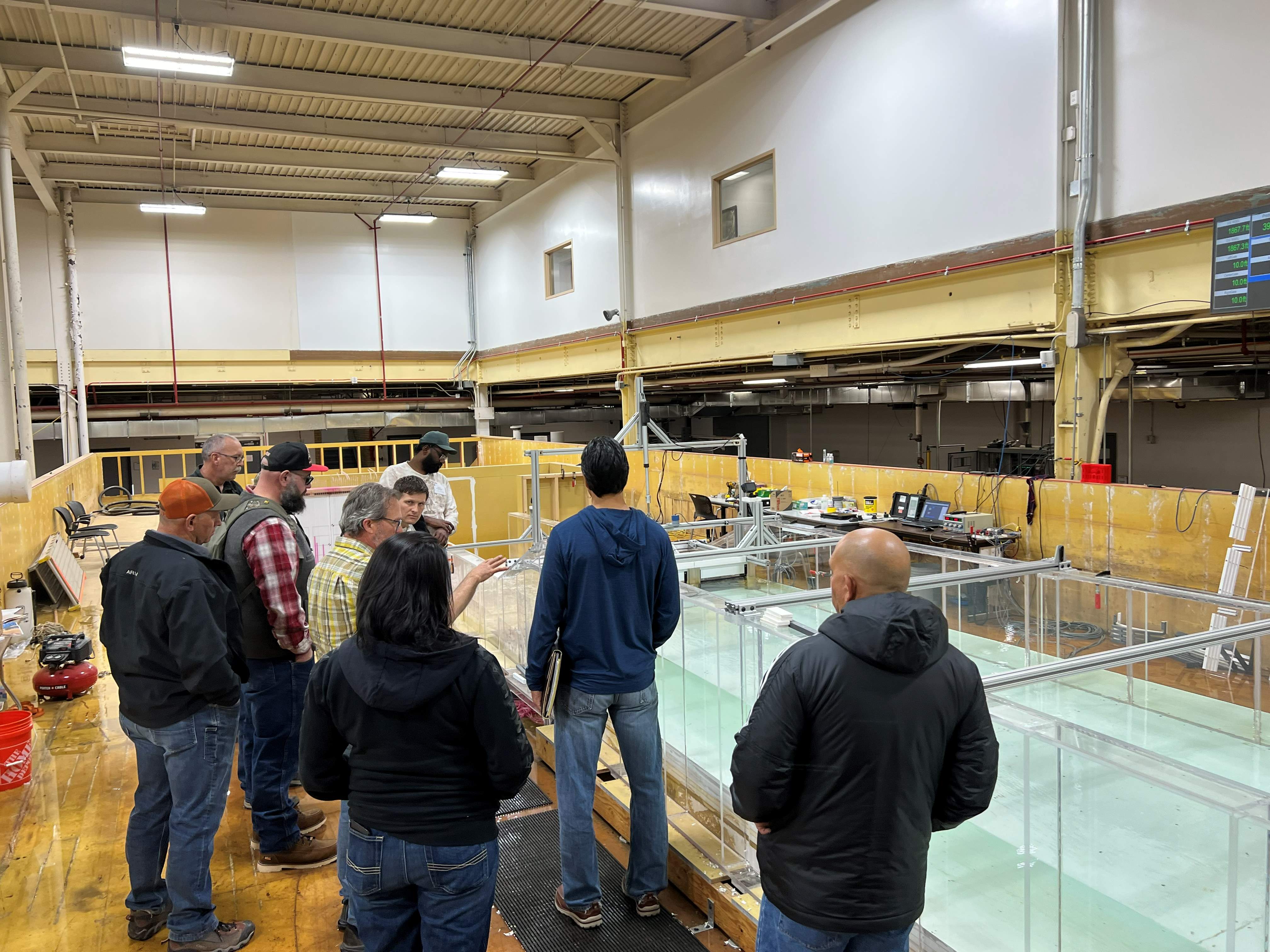
 The Technical Service Center hydraulics lab demonstrates how a dam model is used to test hydrologic loading on spill gates.
This year’s Reclamation Water Management Workshop, held February 10–12, once again delivered best practices and technical guidance on operating and maintaining vital water resource infrastructure across the West. First offered in 1961, the workshop is one of Reclamation’s longest‑running professional gatherings and brings together Reclamation employees, transferred works partners, and the Bureau of Indian Affairs to strengthen shared stewardship of critical facilities.
More than two‑thirds of Reclamation-built assets are transferred works; owned by Reclamation, but operated and maintained by its water user and irrigation district partners. Many of these partners converged at the Denver Federal Center for training on a wide variety of skills needed to sustainably operate and maintain vital infrastructure such as dams, pumping plants, canals, and pipelines.
“Reclamation’s mission would not be possible without the partner organizations who share the stewardship of this infrastructure,” said Dave Palumbo, Deputy Director for Operations. “This workshop equips professionals with a shared set of best practices and the technical know-how to sustain water delivery systems.”
Workshops covered fundamental skills needed to construct or repair facilities and earthwork constructions, while allowing participants to tour Reclamation’s high-tech facilities including the Technical Service Center (TSC) laboratories. Hands-on demonstrations showed participants how to assess soil properties and how to mix, test, and repair concrete. They also learned how to conduct on-site testing of construction materials to assess their general condition and maintenance needs.
The workshop encourages a team training environment for Reclamation employees and partners. Learning together and engaging in open dialogue, networking, and active participation strengthens the collective capacity of the water management community.
Matt Gemperline and Doug Richards from the TSC used a case study of the 2008 breach of Truckee Canal to explain how the risk management principles are key to solving more complex maintenance issues. The TSC conducted a risk analysis of the entire 31-mile canal after a section failed in 2008, damaging hundreds of homes near Fernley, Nevada.
Guest speaker Joel Degner from the Cachuma Operation and Maintenance Board presented a case study of the Sheffield pipeline as a learning opportunity for how to inspect and evaluate large diameter pipelines in built up urban environments. Sheffield pipeline, a 6,000 foot long pipeline 250 feet deep, was built during the 1950s on the Santa Ynez River in California. From its historic setting to the risk of earthquakes in the area, it offered a study in numerous maintenance challenges.
The wide-ranging agenda covered a variety of other issues related to the built environment, including vegetation management, pest control, and invasive species. A remote sensing workshop covered a range of cutting-edge techniques that can be used to detect conditions in hard to access areas, or to map a stretch of river or canal to detect changes over time. Remote sensing methods can include technologies such as drones, acoustic imaging, sonar, lidar, and photogrammetry.
The workshop is organized each year by Reclamation’s Asset Management Office, with assistance from the Technical Service Center.
