


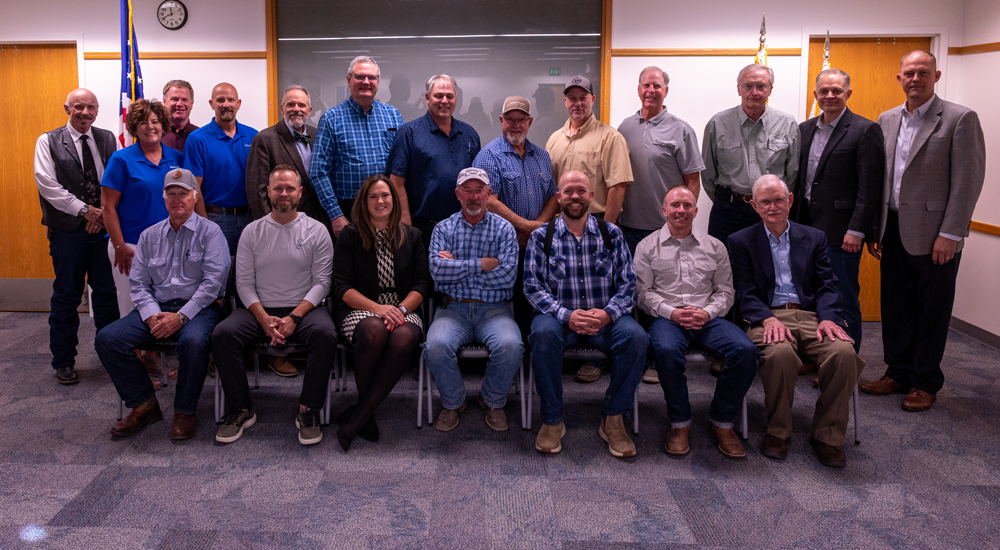
 Gathered signatories of the Strawberry Valley Project 1920 Act Conversion Contract. Reclamation photo by Clint Stone
Provo, Utah — In a landmark moment for the future of water in Utah County, federal, state, and local water leaders gathered today at the Bureau of Reclamation’s Provo Area Office to officially sign the Strawberry Valley Project 1920 Act Conversion Contract. The signing ceremony marks the formal launch of a long-anticipated plan to convert irrigation water from Strawberry Reservoir for municipal and industrial (M&I) use, including drinking water.
The agreement—developed by Reclamation in close collaboration with the Strawberry Water Users Association, the Strawberry Highline Canal Company, municipalities, and other contract holders—reflects years of planning, environmental review, and public engagement. It comes at a critical time, as south Utah County—home to cities like Spanish Fork, Payson, and Salem—faces unprecedented population growth and increasing demand for reliable water supplies. The agreement authorizes the conversion of up to 61,000 acre-feet of water largely used for commercial agriculture and residential outdoor watering, enough to support the needs of approximately 183,000 homes annually.

“This is a proud day for everyone involved,” said Rick Baxter, Manager of Reclamation’s Provo Area Office. “We’ve built a strong foundation of trust with our partners, and today’s signing is the result of that collaboration. This conversion is an effective and efficient way to meet growing water needs without adding new depletions to the system.”
A Smart Solution for a Growing Region
The conversion is authorized under the 1920 Miscellaneous Purposes Act and allows agricultural water users to voluntarily convert their irrigation water to M&I use, providing flexibility while preserving agricultural roots.
“This agreement doesn’t force anyone to stop farming—it simply gives water users the option to adapt,” said SWUA General Manager Sterling Brown. “Farmers can continue irrigating as long as they choose, and if land is sold for development, the water can follow that new use. It’s a practical, forward-thinking solution.”
Key Benefits of the Conversion Contract
The agreement delivers a range of long-term benefits for Utah County and the surrounding region. It supports local growth by helping meet the water needs of a population expected to more than double by 2060, while also preserving agricultural traditions and simplifying water transfers. By utilizing existing infrastructure like the enlarged Strawberry Reservoir and Diamond Fork System, the agreement avoids the need for new construction. Environmentally, it promotes sustainability, as M&I water use often returns more water to the system than traditional agriculture. Most importantly, it future-proofs the region’s water supply, enabling cities to plan confidently for continued growth while maintaining a high quality of life.

About the Strawberry Valley Project
Originally authorized in 1906, the Strawberry Valley Project was one of the first Reclamation projects in the West and has provided reliable irrigation water to south Utah County for over a century. Today’s agreement ensures that legacy continues—adapted for the needs of a growing and changing Utah.
“The Strawberry Valley Project has served this region for more than a century,” said Baxter. “Today’s agreement honors that legacy while preparing us for the future—ensuring that this vital water supply continues to meet the needs of a growing, changing Utah for generations to come.”
