


 Historic images depicting the Reclamation and community response to the near failure of Fontenelle Dam in 1965.
Fontenelle Dam is located in southwest Wyoming and was originally authorized by the federal government for the Seedskadee Project to support water storage for the Colorado River Storage Project and provide regulation of the flows of the Green River for power generation, municipal and industrial use, fish, wildlife, and recreation. Shortly after the reservoir was filled to capacity in the spring of 1965, the dam faced a critical challenge. That September, a leak developed that rapidly expanded into a massive cavity—measuring approximately 80 feet wide, 50 feet deep, and 170 feet long—posing an imminent threat of dam failure. The downstream community of Green River was at significant risk of catastrophic flooding had the dam failed.
In response, local residents joined forces with the Bureau of Reclamation, contributing both labor and equipment in a united effort to stabilize the structure. Their successful intervention not only averted disaster but also showcased the resilience and determination of the people of Southwest Wyoming. The experience provided valuable lessons in dam safety and remains a defining moment in the history of the region’s water infrastructure.
A Near Miss and Lessons Learned
Issues with Fontenelle Dam began in May 1964 when part of the embankment slid into the stilling basin, likely due to a rapid drop in reservoir levels. As the reservoir reached just 10% capacity, seepage was detected at the base of the dam and further downstream from shale outcroppings. Another slide occurred in July 1965.
On Sept 3, 1965, a serious leak appeared at the dam’s west abutment. What started as a wet spot quickly worsened, leading to the loss of 10,000 cubic yards of material into the stilling basin, accompanied by continuing water flow—a condition known as hydraulic piping. Reclamation responded immediately, lowering the reservoir and placing the dam under 24-hour surveillance. The leak escalated into a waterspout, discharging 10–12 million gallons per day.
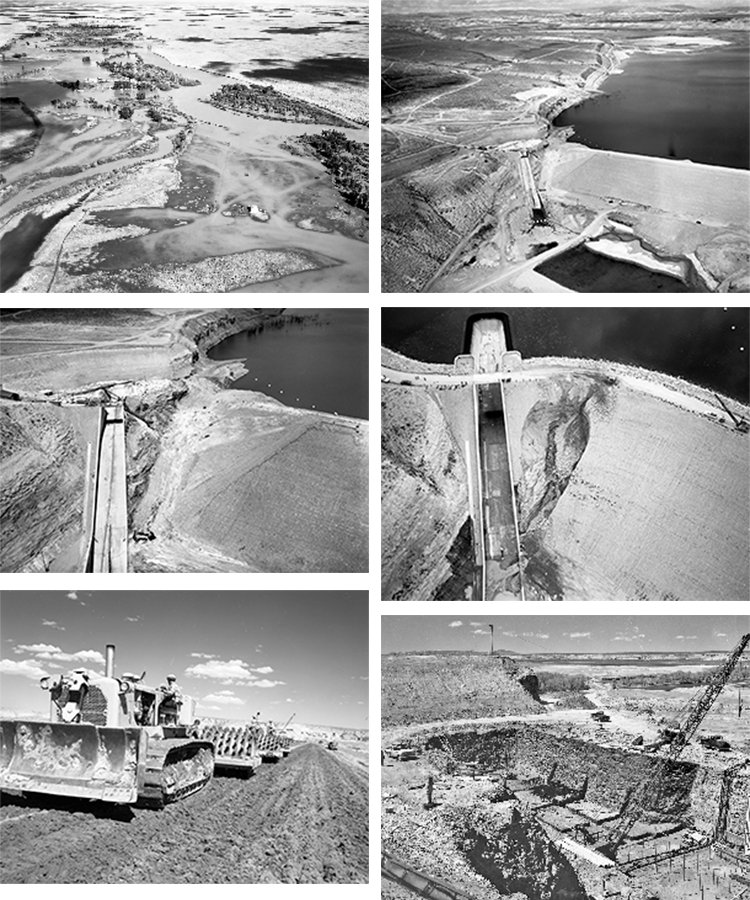 By Sept. 6, a 15-by-20-foot sinkhole formed on the upstream face of the dam’s crest, 30 feet deep and just 45 feet from the downstream face. Crews quickly filled it with riprap to prevent a breach. Fortunately, the dam’s large outlet works allowed the reservoir to be lowered by up to 4 feet per day. Although a catastrophic failure was avoided, emergency releases of water caused flooding downstream, damaging homes and ranches.
Repairs began immediately and continued through 1966, including extensive pressure grouting and full replacement of the right abutment. In 1967, the reservoir was partially refilled to test the repairs, which used 200,000 cubic feet of grout. Water was released through the power penstock while the outlet works were fixed, and 23 observation wells were installed. The reservoir was fully refilled in summer 1968.
Although the dam’s failure was narrowly avoided, the incident prompted changes in dam design and construction practices across the industry. Investigations later revealed that trona-contaminated water used in concrete mixing had weakened the original grout curtain, contributing to the problem.
As a result of the catastrophic failure of the closely similar Teton Dam on the Snake River under much the same circumstances in 1976, ;the Safety Evaluation of Existing Dams (SEED) program was initiated in the late 1970s and early 1980s to perform site evaluations and to quickly identify dams which pose an increased threat to the public, and to quickly complete the related analyses in order to expedite corrective action decisions and safeguard the public and associated resources.
