


Reclamation scientists study the effects of construction noise on wildlife
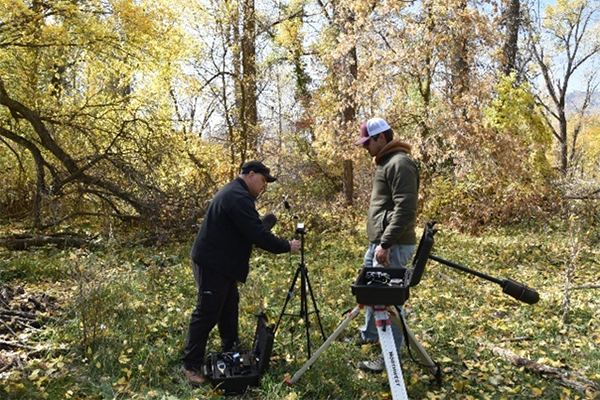 Darin Breunig, Upper Colorado Basin Region Safety Group Industrial Hygienist (left), and Wyatt Carter, Provo Area Office Airport Wildlife Biologist (right), set up a sound level meter near a bald eagle nesting site to determine the level of noise that will come from a future Reclamation construction project at Hyrum Reservoir. (Reclamation photo by Chris Watt)
Occasionally, Reclamation construction projects create noise that is loud enough to adversely affect nearby wildlife. Even temporary sound pollution from construction projects can disrupt the natural behaviors of wildlife in the area, including scaring birds away from their nests during critical times of their life cycles such as egg incubation and raising their chicks.
Previously, when it was determined an active worksite was adversely affecting the normal behavior of nearby wildlife, Reclamation would pause construction while project officials adjusted their schedules, processes and workflow to mitigate any negative impacts. This reactive method is not optimal for wildlife and puts the project at increased risk of delays and higher costs.
“If we found out that the noise was too loud on an ongoing project, then we would likely have to implement certain environmental commitments, such as avoiding the months-long nesting seasons, installing sound barriers, doing species surveys each year during construction, monitoring nests for signs of disturbance, etc.,” said Reclamation Fish and Wildlife Biologist Brittany White with the Provo Area Office’s Water, Environmental & Lands Division. “The contractor's costs can skyrocket, costing hundreds of thousands of dollars more, if they have to implement some of these things during construction.”

Because of this costly risk, Reclamation scientists at the Provo Area Office recently took a proactive stance, performing sound testing near a construction site before the first shovel is turned to find out if the expected noise levels would negatively impact nearby wildlife, specifically the western yellow-billed cuckoo and a nesting pair of bald eagles.

The audio tests took place near Hyrum Reservoir in northern Utah, where the contract to replace the spillway is expected to be awarded in summer 2025. Reclamation scientists and engineers teamed up with a specialist from the Upper Colorado Basin Region Safety Group to set up recording equipment, called sound level meters, specifically designed to measure decibel levels in outdoor work areas.
“I normally do these kinds of workspace safety decibel level tests for people,” said Reclamation Industrial Hygienist Darin Breunig, assigned to the UCBR Safety Group. “This is the first time I’ve done this test for non-humans.”

White and Provo Area Office Airport Wildlife Biologist, Wyatt Carter, determined that October was an ideal time of year to do the audio test since neither the eagles nor cuckoos were in their egg-laying season at that time. The possibilities were, therefore, low that the audio testing would disrupt the birds.
The devices were set up at seven locations near the bird habitats, along the reservoir and adjacent to the Little Bear River. Next, an excavator with a demolition hammer attachment was brought in to break up blocks of concrete to duplicate the kinds of sound levels that are expected to be produced when breaking up and replacing the spillway.

At a coordinated time, the sound level meters were switched on and the excavator driver applied the demolition hammer to four concrete blocks in two different locations around the future construction site. The sound from the destruction was measured and recorded, and the results were analyzed by Reclamation scientists, in collaboration with biologists from U.S. Fish and Wildlife, to determine what effects, if any, the construction noise would have on the eagle and the cuckoo habitats.
“I really like that now we know what this noise will and won't do to these birds, instead of having to make some very conservative assumptions based on the limited information that we would have had [without these tests] and being required to account for those assumptions rather than the actual situation,” said White. “This was, hopefully, a much smaller cost and time investment up front to save potentially much more time and money during the actual construction.”
After compiling and studying the results, White can now report a “no effect” determination for the yellow-billed cuckoo habitat and the bald eagle nest, which means no additional preventative measures are required for Reclamation to implement during construction of a new spillway at Hyrum Reservoir.
After a recent presentation of the results to U.S. Fish and Wildlife Service, White said they were also happy with our test and results.
“The (USFWS) was very impressed with our testing and data points. They’ve even asked if they could share the results with other agencies who are interested in doing similar tests in the future,” said White. “So, it sounds like this testing could be quite useful to us and others when needed.”
