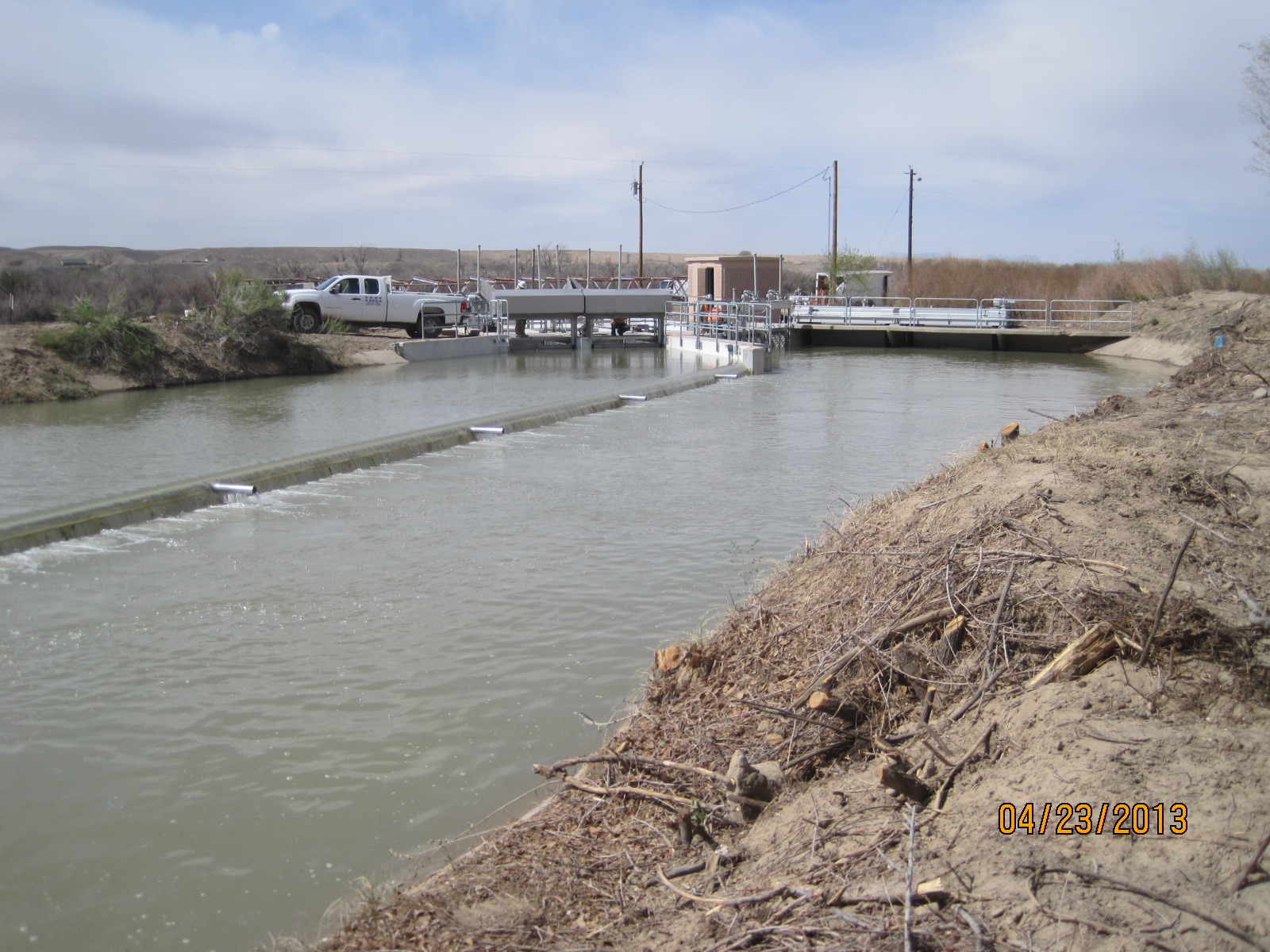


-7.JPG) The Hogback Fish Weir allows the diversion of water into the irrigation canal to the right and guides fish back to the river on the left
The Hogback Fish Weir allows the diversion of water into the irrigation canal to the right and guides fish back to the river on the left
The San Juan River Basin Recovery Implementation Program is funded and implemented by the Bureau of Reclamation to mitigate water development and help recover endangered fish in the San Juan River Basin. Assessing risk to the fish and monitoring their behaviors is an important aspect of this program.
Colorado pikeminnow and razorback sucker, both endangered fish, are known to move extensive distances throughout the Colorado River Basin, which increases their risk of becoming entrained in irrigation canals, such as the Hogback Diversion Canal on the San Juan River near Shiprock, New Mexico. A previous study at this canal showed that entrainment of fish at this diversion was high relative to other diversions (more than 15,000 fish in one year), especially during irrigation season when the diversion can take more than 50% of the water in the river.
The diversion of river water for irrigation or power-generating purposes can have serious consequences for fish. The fish may either become entrained into water diversion intakes or become trapped on intake screens. Fishes with drifting early life history phases (i.e., young-of-year) are very likely to become entrained into water diversions as they are passively transported downstream with the current. Highly mobile fish species (juvenile and adults) are also quite likely to become entrained into water diversions, often as a result of their seasonal movements throughout the river channel. During certain times of the irrigation season, water diversions can take a large portion of the water from a river and entrain fish at proportional levels.
To prevent entrainment, screens are often installed at these canals and canal diversions. However, these often become clogged with debris and quickly fail, which then leads to the screens being removed and fish entrainment continuing. The Hogback Diversion Canal diverts up to 250 cubic feet per second of water from the San Juan River to irrigate various crops in the Farmington and Shiprock, New Mexico, an area that historically had no screens or devices to reduce fish entrainment.
In 2013, an innovative “fish weir” was constructed at this diversion, which greatly reduced fish entrainment. Development of the fish weir was made possible through a process called “value-engineering”, which brought together federal and nonfederal fish biologists, engineers, and other experts to develop an alternative to more traditional approaches like fish screens. Before this installation, no fish-exclusion device of this type had ever been constructed or tested before. This new concept represented a significant improvement over screens and other exclusion devices, which are costly to maintain and are often not operational due to clogging of screens and grates with debris. Due to the success of the Hogback Fish Weir, the design has been copied at several other sites around the United States, with plans to adopt the approach in other countries as well.
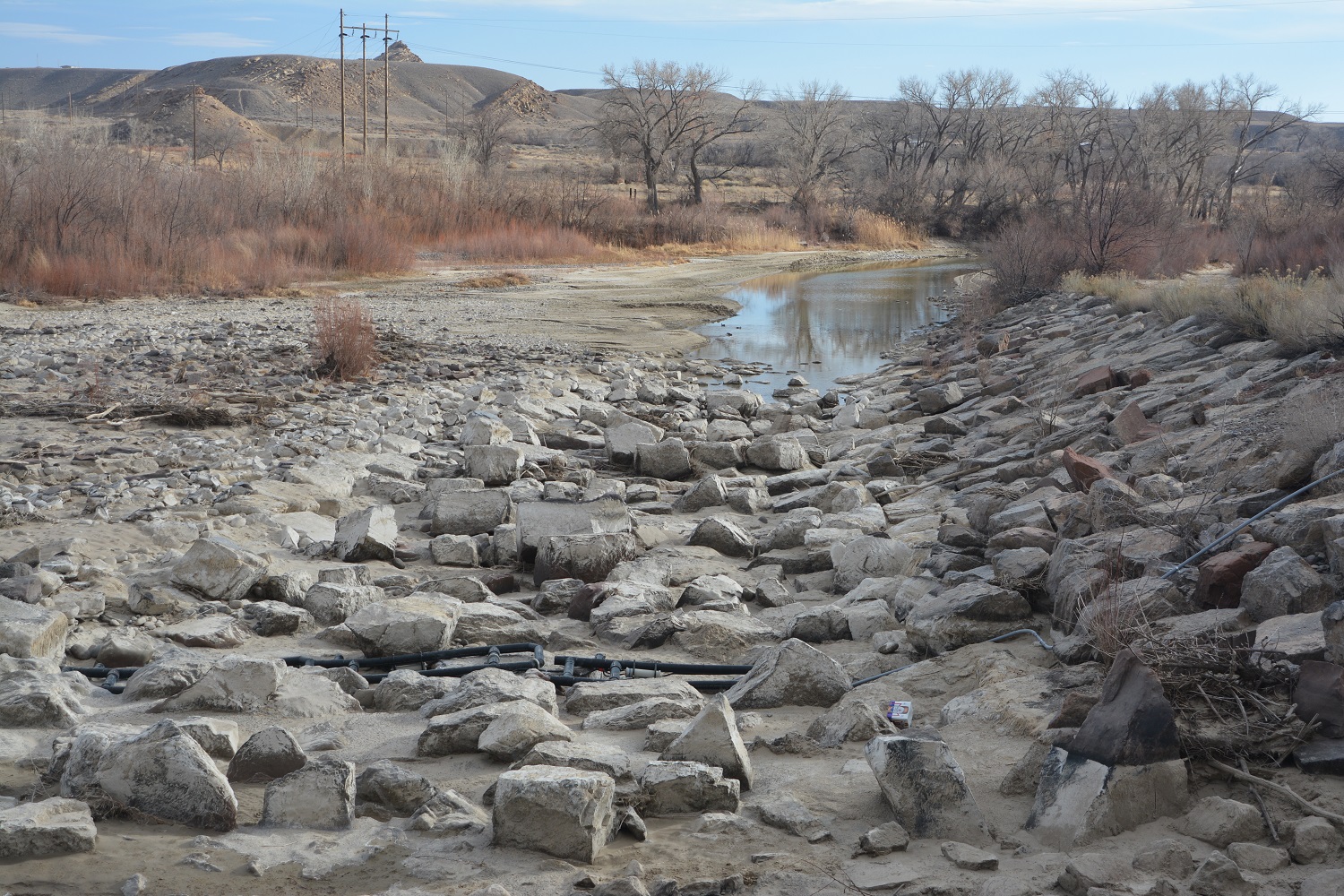
To evaluate the success of the Hogback Fish Weir, it involved Recovery Program biologists Passive Integrated Transponder-Tags, which are tracking tags that do not require power at various locations in the canal as well as in a river bypass that was designed to guide fish through the facility and back to the river. Since the diversion spans the entire width of the river, a fish passage facility was constructed to allow fish to travel around the diversion. Initially, the fish passage did not have PIT-Tag antennas, and this was a significant drawback to evaluating the full effectiveness of both the fish weir and fish passage.
In 2019, the San Juan River Endangered Fish Recovery Implementation Program approved the installation of antennas to evaluate the effectiveness of the fish passage. However, the installation was delayed for 2 years due to COVID-19 closures, as well as river flows and operations that prevented the work. During the week of February 28, the antennas were installed and are now providing data on the movements of fish through the fish passage facility. This data will be used to evaluate how the fish passage works in conjunction with the Hogback Fish Weir and provide information on population numbers, survival, and movements of the endangered fish.
The installation was a cooperative effort between Reclamation, U.S. Fish and Wildlife Service, Navajo Nation, Kansas State University, and Biomark Inc.