 |
|
UC Today is the quarterly newsletter of the Bureau of Reclamation’s Interior Region 7 – Upper Colorado Basin covering the states of Colorado, New Mexico, Utah and Wyoming. We look forward to sharing with you some of the projects and activities that we have been working on to manage, develop and protect water and related resources in an environmentally and economically sound manner in the interest of the American public. October 2019 |
|||
| Albuquerque Area Office | Power Office | Provo Area Office Western Colorado Area Office | Four Corners Construction Office |
|||
|
from the |
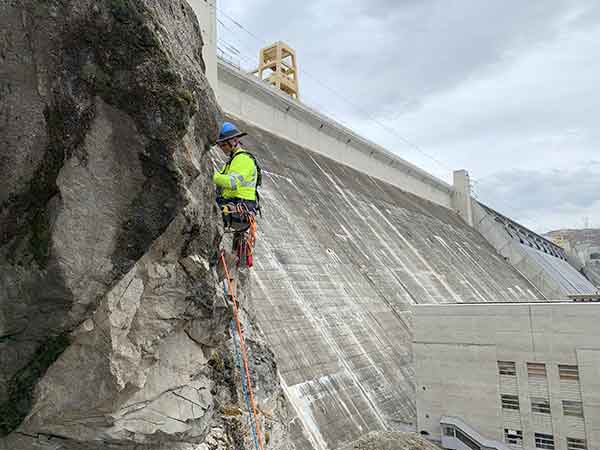 |
| Jerald “Denny” Womack doing rock scaling and vegetation removal above the parking lot between the Right and Third Powerplant. Background is Grand Coulee downstream side of dam and spillway. |
Rope Access Team completes Safety work at Grand Coulee DamBy Benjamin KalminsonThe Interior Region 7: Upper Colorado Basin’s Rope Access Team travelled to Grand Coulee Dam to assist Reclamation’s Columbia-Pacific Northwest Basin with rock scaling, vegetation removal, rock strapping, and rock bolt tightening. In 2017, Reclamation’s Technical Service Center inspection team came out and did a rockfall inspection of the slope above the third powerplant. This inspection identified the areas that needed to be rock scaled, possible strapping or even have rock bolts installed. Rock scaling is a process in which rope access technicians’ decent down ropes to an area that has loose rocks and drops them with pry bars to the ground. This is done to protect infrastructure and personnel. The area below where rocks will be dropped is blocked off so any rock that is removed will not damage infrastructure or personnel. 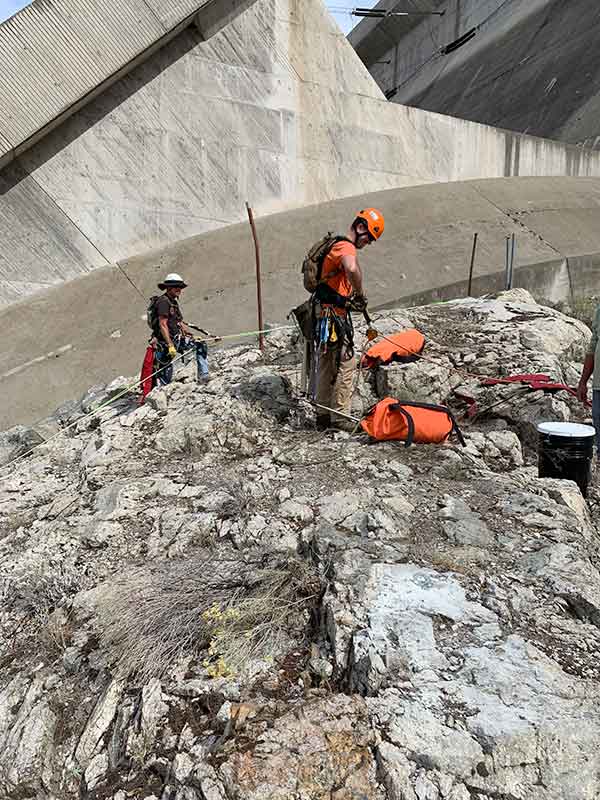 Reece Carpenter and Jerry Tensfield getting connected on ropes to start rock scaling and vegetation removal. Between Penstocks 19 and 20. Rock strapping is when you have infrastructure below an area that has a single large loose rock and dropping the rock would damage the infrastructure. So bolts are placed on either side into stable solid rock and then a cable is placed over the loose rock and tightened down to hold the rock from falling. Rock bolt tightening is a process where a previously identified loose rock was secured by drilling through the loose rock and into solid rock behind it and then an anchor bolt (can be up to 30 feet long or longer to fasten into solid rock) is placed and a plate and bolt are used to secure the rock. Rock bolt tightening includes checking existing rock bolts to a specified torque value to ensure the rock bolt is not loosening. The result of the inspection identified that there is risk to the public parking lot at the base of a cliff face and transformer deck. Potential rocks falling between the penstocks could damage transformers and an oil storage room roof, which would reduce the ability to transmit power from the damaged transformer. The plan focused on the areas that were identified and additional inspection of the rock face was done as well. Climbing anchors had to be established and equipment had to be hauled down elevator and galleries to the rock face. The use of 3,600 foot of rope was utilized to accommodate the six rope technician's work. The job was completed in September of 2019. The ten-person team consisted of: Reece Carpenter and Jerry Tensfield from the Western Colorado Area Office; Dale Hamiliton, Gary Henrie and Rachelle Vanderplas from the Provo Area Office; Mark Neely from the Power Office; and Benjamin Kalminson, Gregory Pate, Ronald Hoskins, Corey Kidwell and Denny Womack from the Elephant Butte Field Division. The team worked hand in hand with the staff at Grand Coulee to ensure proper safety protocol was followed using an established a work plan from the TSC. |
|
from the |
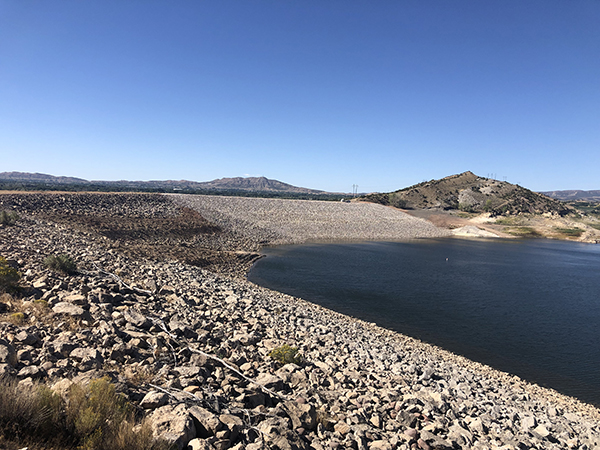 |
| View from left abutment looking the the reconstructed right abutment embankment and outlet works at Steinaker Dam. |
Steinaker Dam resumes normal operationsBy Darrick WhippleIn July 2018, Reclamation began modification work to repair a slope failure on the upstream face of the right abutment of Steinaker Dam by flattening the abutment slope. Other modifications included extending the outlet works intake to accommodate the flattened embankment, re-coating the outlet work gates and installing a new hydraulic system for gate operation. The Dam safety modifications at Steinaker Dam is substantially complete. The construction costs totaled about twenty million dollars. 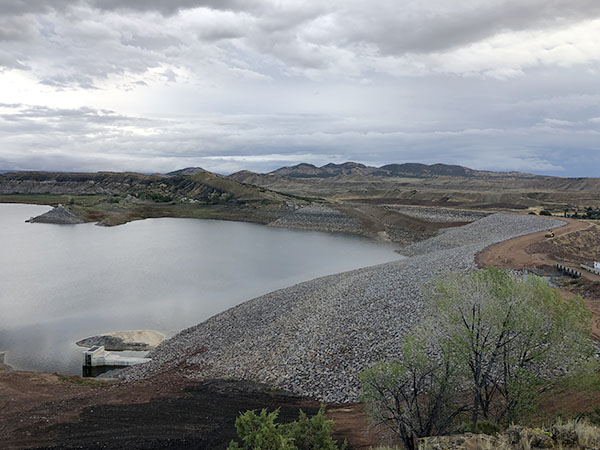 View from right abutment looking at the reconstructed dam embankment on the right abutment and the new intake structure for the outlet at Steinaker Dam. Dam safety modifications were performed by Weeminuche Construction Authority Inc., located in Towaoc, Colorado and owned and operated by the Ute Mountain Ute Tribe. The organization’s hard work and technical capabilities are impressive. With the improvements, Reclamation, the Uintah Basin Water Conservancy District and the basin’s water users can all look forward to the continued safe and successful operation of this facility. The dam provides off-stream water storage from Ashley Creek and is an important feature of the Vernal Unit of the Central Utah Project. The dam and reservoir provide certainty and reliability for water users in the Uintah Basin — delivering 15,000 acre-feet of water each year for irrigation. The reservoir also provides excellent fishing, boating, water skiing and other recreational opportunities. |
|
from the |
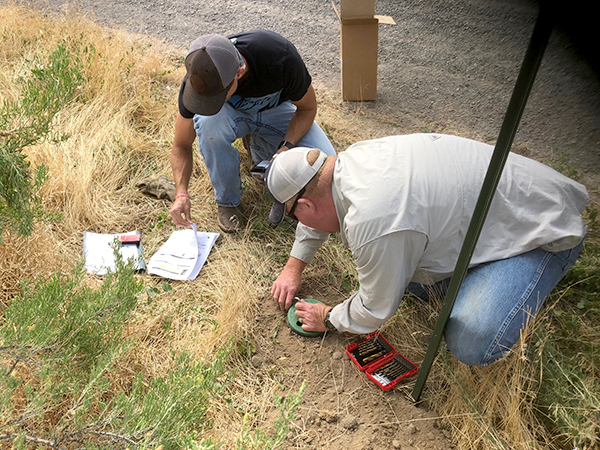 |
| From left: Cory Lidberg and Griff Shireman, Western Colorado Area Office employee's install a trail counter to help assess trail use and to better plan future projects in Fruitgrowers Reservoir areas. |
Western Colorado Area Office focusBy Justyn LiffFruitgrowers Reservoir Traffic CountersWestern Colorado Area Office staff recently placed trail counters to count pedestrian use and traffic counters to detect vehicle use at WCAO sites. Data gathered will provide numbers for the Recreation Use Data Reports and will be considered when upgrades and changes are made at the sites.. Visitation numbers can also help justify recreation fund expenditures by showing the number of people visiting the areas. Trail counters were installed at Horsethief Canyon Wildlife Area, Grand Junction Wildlife Area, Orchard Mesa Wildlife Area, Simon Draw Wildlife Area and Hammond Mitigation Site. Traffic counters were installed at HCWA, DeBeque Wildlife Area, Fruitgrowers Reservoir and Miller Mesa. Replacement of Bulkhead and Regulating Gates at Paonia DamIn November 2019, construction will begin on replacing the bulkhead and regulating gates at Paonia Dam. The original bulkhead was removed in the winter of 2017, due to damage. The regulating gates need replaced due to age and wear. The $4.5 million contract was awarded to Gracon LLC, the completed work allows normal operations at the dam to continue. Work will be completed in April 2021. 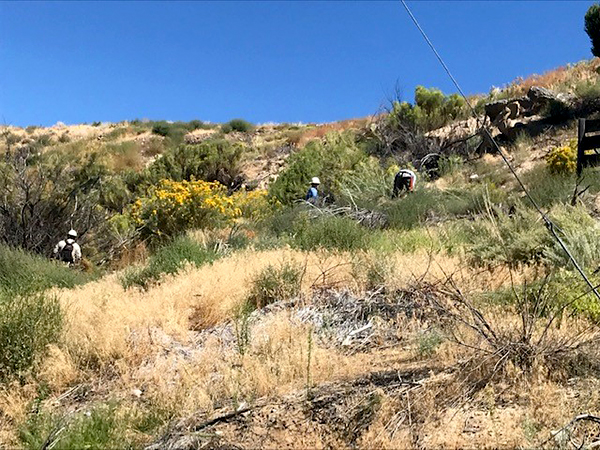 BLM Firefighters removeing trees and brush at Navajo Dam Navajo Dam Vegetation Clean-upThis fall a fire crew from the Bureau of Land Management’s Farmington Office removed invasive/non-native species and woody growth including; Russian olive, salt cedar, cottonwood and rabbit brush at Navajo Dam. The crew cut down the invasive trees and brush and sprayed tree stumps to keep them from growing back. Removal of the non-native brush will make it easier to monitor for seepage at the dam and reduce fire risk. Paradox Environmental Impact StatementThe WCAO is working diligently on preparing the draft Paradox Environmental Impact Statement to be released for public review this fall. The Paradox Valley Unit, in Montrose County, Colorado, was constructed to assist in reducing the salinity of water delivered to users in the United States and the Republic of Mexico. The Unit, which is nearing the end of its useful life, consists of facilities to intercept shallow brine groundwater and inject it into the Leadville geologic formation via a deep injection well. Reclamation is preparing the EIS to identify and evaluate brine disposal alternatives to replace the existing brine injection well. The internal review and cooperating agency review of the draft EIS has been completed and the WCAO is finalizing the draft EIS for public release. More information is available at: https://www.usbr.gov/uc/progact/paradox/index.html. Salinity UpdateThe Western Colorado Area Office recently released a final Finding of No Significant Impacts and Environmental Assessment on a salinity control project on the Gould Canal to improve 12.4 miles of the canal with a combination of buried pipeline and concrete lining. These improvements will reduce seepage along the canal, enhance water supply and improve water quality by preventing approximately 5,697 tons of salt per year from entering the Colorado River. Construction will begin in the near future. |
|
from the |
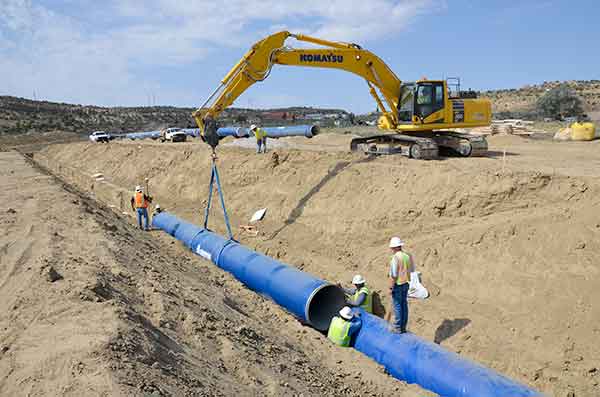 |
| Installation of pipe along Reach 12A of NGWSP |
Latest Construction Contract Awarded on Navajo-Gallup Water Supply ProjectBy Hubert “Chico” QuintanaOn September 12, the Bureau of Reclamation awarded the latest section of the Navajo-Gallup Water Supply Project, Block 4C-8, to Oscar Renda Contracting, Inc., of Roanoke, Texas, for $83.7 million. This section of the project will include construction of nearly 30 miles of 48-inch and 42-inch diameter pipeline spanning from the Navajo communities of Little Water to Naschitti, New Mexico. 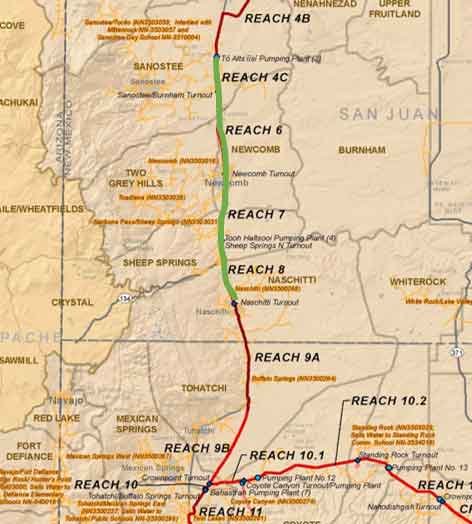 The green line shows the nearly 30 miles of pipeline that will be constructed.
Work under this contract will begin in January 2020 and is expected to last for approximately 2 years. Construction will be visible from U.S. Highway 491. |
|
from the |
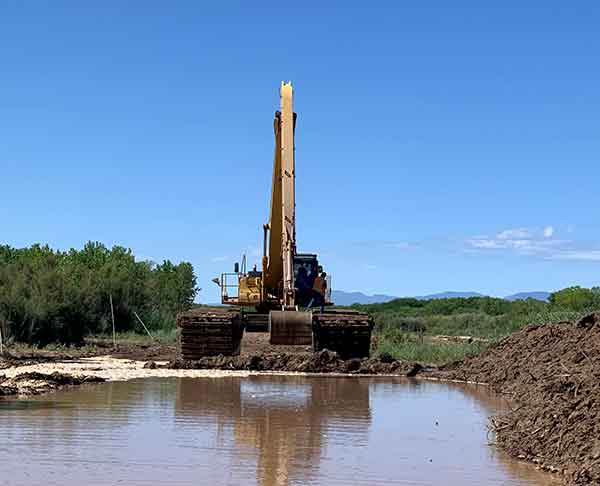 |
| The Socorro Construction crew excavates a new pilot channel in October around a plug that formed in the Rio Grande south of Socorro, New Mexico in the Bosque del Apache Wildlife Refuge. |
Reclamation Reroutes the Rio GrandeBy Mary CarlsonWater is flowing down to Elephant Butte through a new channel as part of a Reclamation pilot project to realign a portion of the Rio Grande around a sediment plug. The Albuquerque Area Office’s Socorro construction crews mobilized in September to excavate the channel that had already partially formed naturally this year within the Bosque del Apache National Wildlife Refuge. While water levels were high, water continued to flow around the plugged area with minimal reductions in flow reaching Elephant Butte.
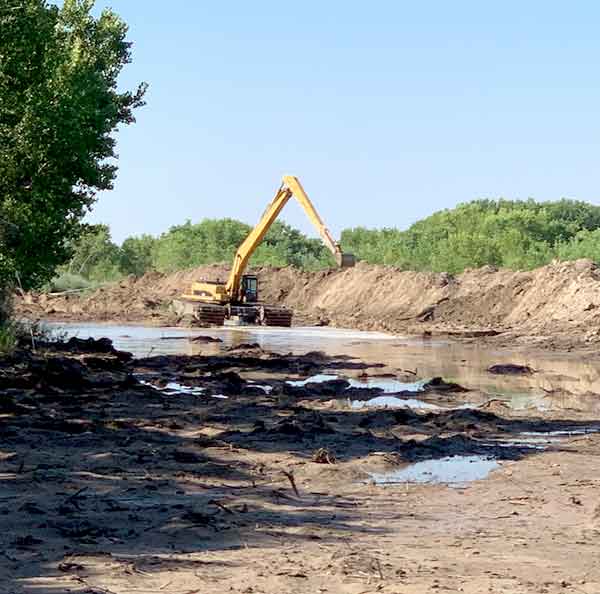 An amphibious excavator is used to move dirt and assist the Rio Grande in traveling down a new path to Elephant Butte Reservoir during construction by the Albuquerque Area Office's Socorro construction crew. The Rio Grande is being rerouted in an area that has historically plugged with sediment during high flow years. Sediment plugs occur at this location because the river channel is perched above the adjacent floodplain. Most of the sediment in the river moves along the bottom of the channel. As water levels rise above the river banks during high flows, water leaves the main channel and inundates the overbank area. The water remaining in the channel becomes concentrated with sediment, which deposits rapidly and fills the main channel with sand. Channel plugging most recently occurred in 2017. The realignment project aims to reduce plugging, improve downstream water delivery and direct water away from important riverside infrastructure. This pilot project within Reclamation’s River Maintenance Program will provide data and could lead to additional realignment work in the area. The main part of the project was completed in early October, before the Middle Rio Grande Conservancy District began moving water down to Elephant Butte for delivery to Texas under the Rio Grande Compact. However, work continues to widen the channel. |
Commissioner Burman's Message on New LogoThe Bureau of Reclamation is modernizing our visual identity, including the logo, as part of a proactive effort to better articulate the important work we do. The new visual identity and logo improves accessibility, is more suitable for digital communications, and can be more uniquely and directly associated with Reclamation. |



Interior Region 7 • Upper Colorado Basin 125 South State Street, Room 8100 Salt Lake City, Utah 84138-1147 If you would like to subscribe or unsubscribe to this newsletter, please send an email with your first and last name to ucbpao@usbr.gov. |