 |
|
UC Today is the quarterly newsletter of the Bureau of Reclamation’s Upper Colorado Basin Region covering the states of Colorado, New Mexico, Utah and Wyoming. We look forward to sharing with you some of the projects and activities that we have been working on to manage, develop and protect water and related resources in an environmentally and economically sound manner in the interest of the American public. July 2022 |
||||||
| Upper Colorado Basin Region Office | Albuquerque Area Office Power Office | Provo Area Office |Western Colorado Area Office | Four Corners Construction Office |
||||||
|
from the |
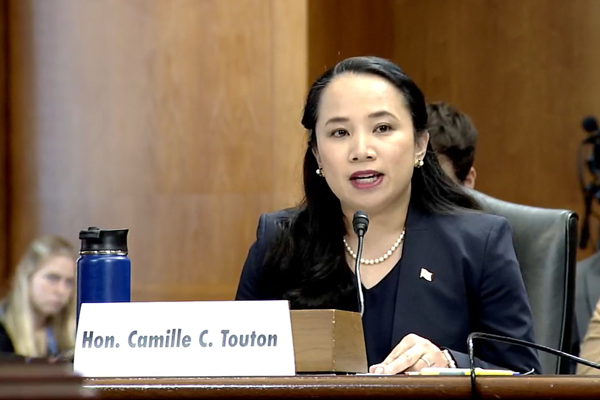 |
| Commissioner Camille Calimlim Touton. |
Commissioner Touton asks Basin States and Tribes to conserve an additional 2-4 million acre-feet of water in 2023By Upper Colorado Basin Public AffairsIn June, Reclamation Commissioner Camille Calimlim Touton provided testimony to the Senate Committee on Energy and Natural Resources regarding extreme drought in the Western U.S. Commissioner Touton's remarks were delivered as part of her testimony during the full committee's hearing to examine Short- And Long-Term Solutions To Extreme Drought In The Western U.S. Her testimony focused on the management of the system and the actions Reclamation is taking to manage this moment-- and into the future. "Unprecedented is now the reality and the normal in which Reclamation must manage our systems," said Touton. "The expectation of a warmer drier West in the future is what we are seeing today." To manage the impact of the historic drought, Touton noted that "Reclamation is responding basin by basin and engaging in actions to mitigate the impacts of a drying landscape. We are utilizing our operational and financial authorities as we take this challenge, based on the best available science. And we take these actions on with our partners across the basins." Despite our actions over the past two decades, the Colorado River system remains at risk. Reclamation's Protection Volume Analysis details the volume of additional water conservation needed to be confident that specific elevations at Lake Powell and Lake Mead will be protected for the next four years (2023-2026). The analysis shows—depending on Lake Powell's inflow—that the additional water or conservation needed ranges from 600,000 acre-feet to 4.2 maf annually. During her testimony, Touton asked the Colorado River Basin States and tribes to come up with consensus solutions for how an additional 2-4 maf can be conserved in 2023. She seeks to have a response from them by August 16 when the August 24-Month Study will be released. The August 24-Month Study sets the operational tier for coordinated operation of Lake Powell and Lake Mead for the year ahead. To see her full testimony, visit: www.usbr.gov/newsroom/#/congressional-testimony/4241 |
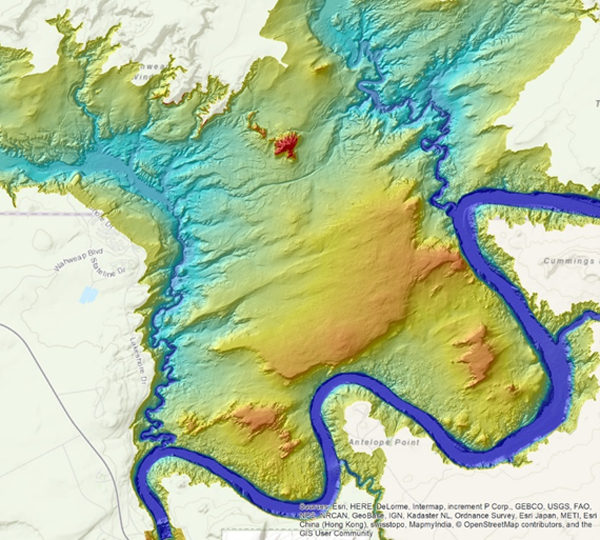 |
| Topobathymetric elevation model of Lake Powell, photo by USGS. |
Bathymetry data incorporatedBy Upper Colorado Basin Public AffairsEarlier this year, we shared the findings of a new scientific investigation report compiled by the U.S. Geological Survey in cooperation with Reclamation that updated the storage capacity for Lake Powell, following more than 30 years of naturally occurring sedimentation accumulation since the last survey in 1986. The report is based on data collected in 2017-2018 and revealed that Lake Powell's storage capacity has decreased 6% at current elevation (which is equivalent to 4% at full pool). Based on the reservoir's current elevation, that is equivalent to a loss of approximately 443,000 acre-feet. Reclamation converted the SIR's data into a compatible format and incorporated the new area-capacity tables into the reservoir's databases for use by its operational models on July 1. Results from the sensitivity studies show higher Lake Powell elevations in the future with decreased annual release volumes as Powell and Mead balance contents under the Lower Elevation Balancing Tier within the 2007 Interim Guidelines. Decreased storage at Lake Powell also positively benefits future recovery efforts with less inflow needed to increase elevations. |
|
from the |
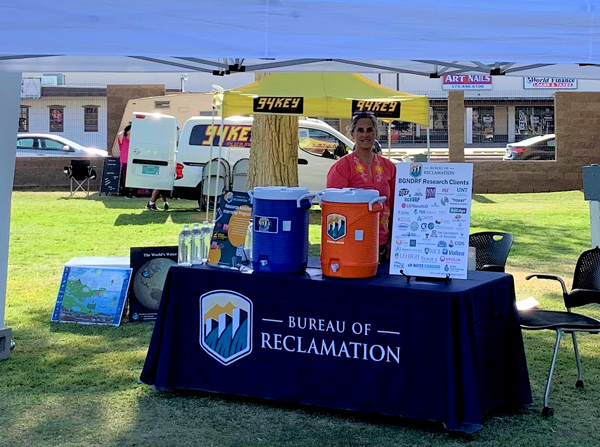 |
| Malynda Cappelle at Alamogordo Earth Day. Reclamation photo by Crystal Bing |
Summer Activity Picks Up at Brackish Groundwater National Desalination Research FacilityBy Crystal Bing, Facility Operations Assistant - Alamogordo Field DivisionIt feels like summer! The temperatures are rising and Reclamation's Brackish Groundwater National Desalination Research Facility (BGNDRF) is busy. The staff are hard at work providing support to clients, performing operations and maintenance duties and making plans for the future. We're excited to be back out in the community. The team participated in the Alamogordo Earth Day and a local middle school STEM Night this spring. The Alamogordo Earth Day event, hosted in April at Alameda Park Zoo, was the staff's first large outreach event in two years.
To close out the school year, Chaparral Middle School hosted a STEM Night. BGNDRF staff brought displays showing salinity, desalination with renewable energy, and fun, hands-on opportunities. Upcoming sixth graders from local elementary schools were invited to attend. Many of these students were the last group to participate in the annual Discovering Desal event prior to 2021 and the Covid-19 lockdown, local third graders came to BGNDRF annually.
BGNDRF is on pace for 2022 to be a record setting year. There are more projects planned this year than ever before and the facility is getting tested to its limits. Current and upcoming clients doing research at BGNDRF include ECOVAP, LG Chem, Massachusetts Institute of Technology University of North Texas, University of Texas El Paso, Osmoflo, Solar Multiple and WaterSurplus. BGNDRF staff are also preparing for the 5th Annual Water Innovations and Networking or WIN Workshop. It is scheduled for September 20-21. Registration is open through Eventbrite at https://5th-annual-bgndrfwin.eventbrite.com. For more information, you can also visit the WIN Workshop website at https://www.usbr.gov/research/bgndrf/win.html. |
|
from the |
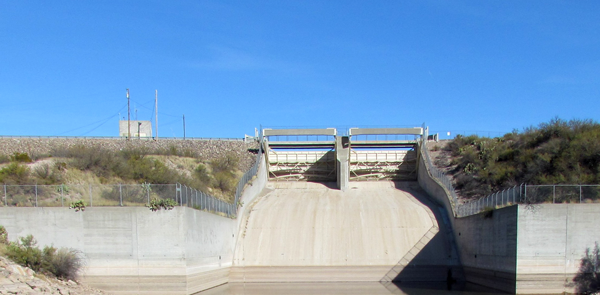 |
| Caballo Dam spillway. Reclamation photo by Benjamin Kalminson |
Power Office completes maintenance workBy Gregory Pate, Maintenance Worker - Elephant Butte Field DivisionThe Power Office has been busy making significant progress on general maintenance and the upkeep of dams in the region. Here we share details of two recently completed projects that are great examples of the type of work our crews do across the region to keep our dams fully operable. Radial Gates Recoating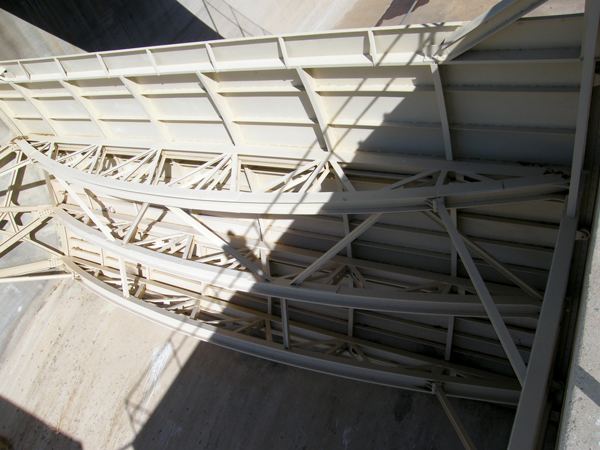 At the Elephant Butte Field Division's Caballo Dam Reservoir, work is underway to recoat the surface of the radial gates. Over the years, precipitation and other naturally occurring events have aided in the reduction of coating integrity and the oxidation of the metal. Unfortunately, the skeletal surfaces have accrued the worst of this oxidation so this work is critical to the longevity of the structure. Crews will sandblast the rusted areas and then prime surfaces with a heavy zinc primer to aid in the decrease of ultraviolet degradation. A marine type of topcoat that should protect against precipitation will then be used to further preserve the radial gates. Since the larger I-beam connection can hold water, those areas of the gates will require close attention. Most of the work being performed will be done from a manlift due to the height of the gates. With proper preparation of the metal surfaces and proper application of the coatings, the radial gates should be able to last for many more years to come. Concrete Repaired on Caballo SpillwaysIn April of 2021, the Upper Colorado Region's Elephant Butte Field Division began a project at the Caballo Dam Reservoir to replace the spalling concrete on the downstream side of the spillway. There were various areas along the spillway that needed replacement, the largest being approximately 30 feet long by 4 feet wide and the smallest at approximately 2 feet wide by 3 feet long. If left in disrepair, water flowing over the spalled and cracked surfaces would flow underneath the spillway causing soil erosion leading to further concrete collapse, so these repairs were critical to the integrity of the spillway. Each of the areas were cleared of the spalled concrete and prepared by installing new rebar. Approximately eight cubic yards of concrete was poured to reestablish the integrity of the Caballo spillway. The repairs to the spillway are now complete and will further the life of the spillway and the overall functionality of the Caballo Dam. |
|
from the |
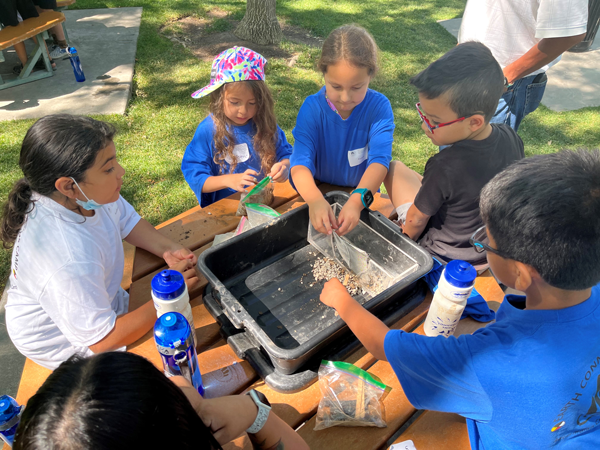 |
| Earth Connection campers at the Thanksgiving Point camp work on building their earthen dam. Reclamation photo by Chris Watt |
After a 3-year pause, Utah's Earth Connections Camp is back!By Chris Watt, Upper Colorado Basin Public AffairsThe Earth Connections day camp for Native American youth teaches many of the cultural heritage crafts and traditions that some elementary, middle and high school students are not always exposed to while living in cities and towns outside of their nations, lands, and pueblos. In addition to cultural heritage, students are taught about careers and education in science, technology, engineering and mathematics (STEM) by career professionals from Reclamation, Bureau of Land Management, Natural Resources Conservation Service and Forest Service (NRCS), Utah Division of Wildlife Resources, and other federal and state partners. 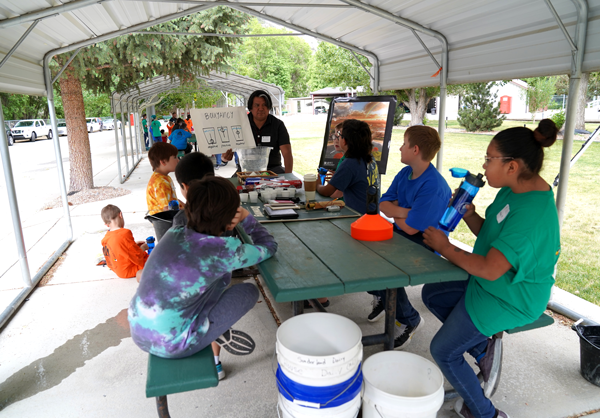 Reclamation presented two of the STEM learning stations that covered dam building, engineering activities and learning. Nathaniel Todea, a civil engineer assigned to the UCB Region Power Office, worked together with Candice Hasenyager, Director of Utah Division of Water Resources, to teach a class on water supply, water delivery, the hydrologic cycle, and buoyancy that included an activity where the students used surveying equipment to get the lay of the land around the camp. UCB Region public affairs specialists Clint Stone and Chris Watt taught a class on the types and purposes of dams and then sent the kids to work building their own earthen dams in an activity to see which team's dam could hold water the longest. This year, Reclamation instructors also focused on teaching about the drought in the southwest, the ways Reclamation professionals past and present have managed to save and use the water we have, and the need for continued water conservation practices. "You have started the process to support the academic and cultural pathways for the students and what it may take to be successful," said Dr. Chuck Foster, American Indian Education Specialist for Utah State Board of Education Title VI programs, and cofounder of Earth Connections Camp, to organizers, instructors, and support staff. "Your willingness and desire help mold the minds and spirits of students to become better people was outstanding. Your knowledge and aspirations to bring Native culture and academia in STEM was excellent." Foster continued, "I believe the students had a blast and enjoyed themselves surrounded by a support group of their peers." Watt, who has represented Reclamation at five years of Earth Connections Camps, said, "These are great days out in nature, we have the opportunity to teach enthusiastic students about the world around them and how Reclamation manages the limited water resources, then turn the kids loose to test their new knowledge and build an earthen dam with mud they make themselves. What's not to love?" 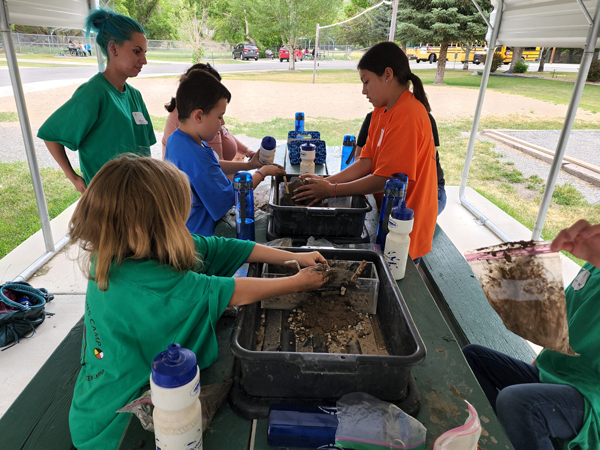 The day camp was held in three locations in Utah: at Thanksgiving Point in Lehi, Red Butte Garden in Salt Lake City and Ophir Canyon Educational Center in Ophir. The camps' many supporters and organizers include the Utah State Board of Education; The Urban Indian Center of Salt Lake; Nebo, Alpine, and Tooele School Districts; Tooele Education Foundation; Confederate Tribes of the Goshute Reservation; Skull Valley Band of Goshutes; Red Butte Garden; Natural History Museum of Utah; Thanksgiving Point Institute; University of Utah (Native American Research Internship and American Indian Resource Center); Utah Division of Water Resources; and federal agencies from the Department of the Interior and the U.S. Department of Agriculture. |
|
from the |
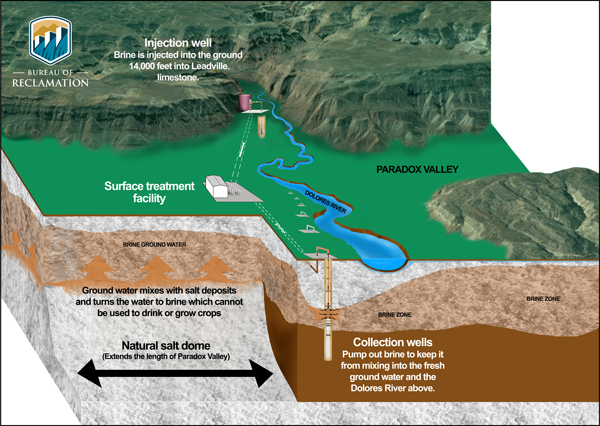 |
| Reclamation illustration by Chris Watt |
Six-month test of injection well underway at Paradox Valley UnitBy Justyn Liff, Western Colorado Area Public AffairsSalinity control operations resumed at a reduced rate on June 1, as part of a six-month injection test at the Paradox Valley Unit (PVU) injection well. The injection well, located in a remote area of western Colorado along the Dolores River in Montrose County, prevents an average of 95,000 tons of salt from entering the Dolores and Colorado rivers each year. Prior to the restart, the Paradox injection well had been shut down since March 2019, when a 4.5 magnitude earthquake was recorded near the site. Though there was no damage to the well or surrounding area, injection was suspended to model injection formation pressure, monitor and analyze seismic activity, and perform a seismic hazard analysis to ensure safe operation. Reclamation determined that seismic activity at the site had significantly decreased and that resuming operations at a reduced rate under close watch was appropriate.
The six-month-long operational test will consist of injecting brine groundwater into the 16,000-foot-deep well at a reduced rate of 115 gallons per minute, which is 67% of past operations. Reclamation and contracted staff are working onsite to perform operation and maintenance functions and closely monitor the injection pressure, and Reclamation geophysicists in Denver are monitoring the seismic response. If any unfavorable conditions develop, such as increased frequency or magnitude in seismicity, operation will be suspended until it is deemed safe to continue. The injection test results will be used to evaluate well conditions and help Reclamation create a plan for potential future injection operations. A seismic risk analysis will be completed in 2023 and an operations plan may be developed based upon the injection test results. For more information about the PVU, visit our website. |
|
from the |
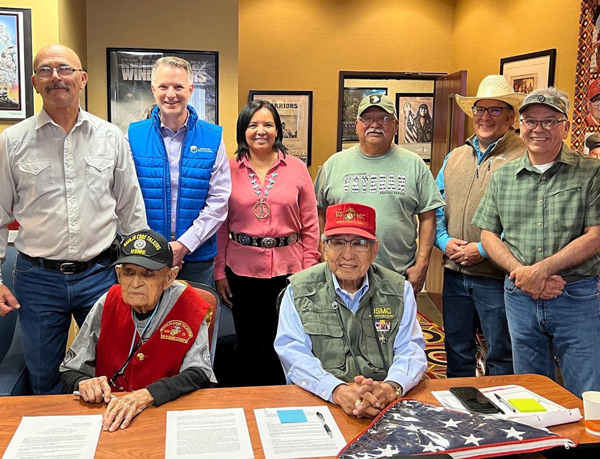 |
| Front row: Navajo Code Talkers Samuel Sandoval and Peter MacDonald Sr. Reclamation photo |
Navajo Code Talkers Museum Board signs NGWSP Reach 12.2 Water Transmission Pipeline Right-of-WayBy Ryan Seamus Royer, Civil Engineer and Jim E. Formea, Realty Specialist, Bureau of ReclamationOn Friday April 22, after more than nine years of coordination and negotiations, the Navajo Code Talkers Museum (NCTM) board approved a right-of-way contract for installation of a 24-inch water transmission pipeline, granting Reclamation the ability to construct the Reach 12.2 pipeline across the NCTM property east of Tse Bonito. The Reach 12.1 and 12.2 pipeline, also named the Navajo Code Talkers Sublateral as a tribute to our heroes, is a part of the NGWSP and will provide a consistent supply of clean, potable drinking water to the Navajo people who live and work in the surrounding area, including the Window Rock/Ft. Defiance communities. In addition, Reclamation and the NCTM board also signed an agreement for the installation of a tee connection on Reach 12.2 and additional infrastructure which will provide project drinking water to the future NCTM. Reclamation anticipates construction for this section of the NGWSP to start in late 2022, with water delivery scheduled for 2028--after the completion and commissioning of the San Juan Lateral Water Treatment Plant and associated pipeline and pumping plants. It is with great pride and honor that Reclamation was able to partner with the NCTM to help bring water to Navajo communities and the future Code Talkers Museum. Ahéhee Code Talkers, and ahéhee NCTM! |
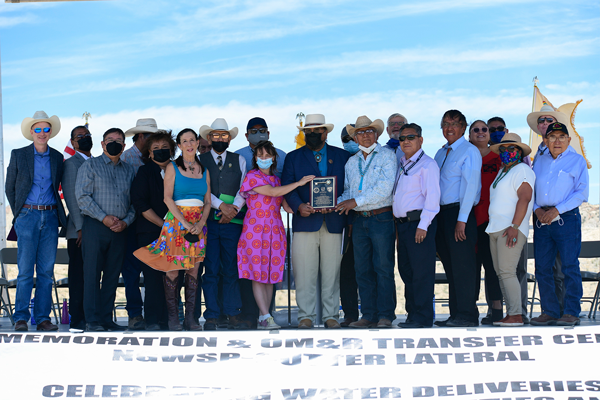 |
Cutter Lateral Partners Celebrate Cutter Lateral Completion and Transfer of Operation Maintenance and Replacement Responsibilities to Navajo Nation and NTUABy: Becky Begay, Navajo Outreach Coordinator and Bart Deming, Construction Engineer, Bureau of ReclamationOn a hot, breezy, sunny day June 9, the Navajo Nation and the Bureau of Reclamation welcomed the U.S. Department of Interior's Assistant Secretary for Water & Science Tanya Trujillo, New Mexico Congresswoman Theresa Leger-Fernandez, and representatives from Cutter Lateral Chapter Officials, the State of New Mexico, Jicarilla Apache Nation, Navajo Tribal Utility Authority, Bureau of Indian Affairs, and City of Gallup to Dzilth-Na-O'Dith-Hle, New Mexico to celebrate the completion of the Cutter Lateral and transfer of operation, maintenance and replacement (OM & R) responsibilities for Reclamation-owned Reaches 22a, 22b, and the Cutter Lateral Water Treatment Plant to the Navajo Tribal Utility Authority. NTUA already owns and operates the Cutter Lateral reaches south of the water treatment plant.
The significant event highlighted the completion of the first half of the Navajo-Gallup Water Supply Project with the Cutter Lateral. The Cutter Lateral was completed in October 2020 and has been providing reliable and clean drinking water to eight of the eastern Navajo Nation communities: Counselor Chapter, Pueblo Pintado Chapter, Burnham Chapter, Ojo Encino Chapter, Huerfano Chapter, Torreon/Star Lake Chapter, Whitehorse Lake Chapter, and Nageezi Chapter, and later this year to the Jicarilla Apache Nation. The celebratory event acknowledged the hard work and collaborative partnership between the Navajo Nation and Navajo Chapters, Reclamation, Jicarilla Apache Nation, NTUA, Jacobs, Souder Miller & Associates, and Navajo Engineering Construction Authority in making water deliveries to indigenous communities a reality. |



Interior Region 7 • Upper Colorado Basin 125 South State Street, Room 8100 Salt Lake City, Utah 84138-1147 If you would like to subscribe or unsubscribe to this newsletter, please send an email with your first and last name to ucbpao@usbr.gov. |