 |
|
UC Today is the quarterly newsletter of the Bureau of Reclamation’s Upper Colorado Basin Region covering the states of Colorado, New Mexico, Utah and Wyoming. We look forward to sharing with you some of the projects and activities that we have been working on to manage, develop and protect water and related resources in an environmentally and economically sound manner in the interest of the American public. January 2020 |
|||
| Albuquerque Area Office | Power Office | Provo Area Office Western Colorado Area Office | Four Corners Construction Office |
|||
|
from the |
 |
| Stateline Dam, on the East Fork of Smiths Fork within the Uinta-Wasatch-Cache National Forest in Utah |
Automation Group Works to Provide Data, Increase Security, and Make Facility Features Controllable by SmartphoneBy Darrick WhippleThe Provo Area Office Automation Group installs, programs and calibrates a large variety of water control and security systems across the western US. A few examples of the Group’s work include:
|
|
from the |
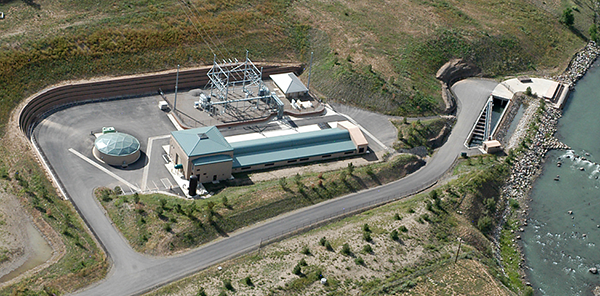 |
| Durango Pumping Plant |
Western Colorado Area Office focusBy Justyn LiffDurango Pumping Plant ConstructionThis winter modifications began on the intake structure at the Durango Pumping Plant; the feature used to pump water from the Animas River to Lake Nighthorse, part of the Animas-La Plata Project located in Durango, Colorado. The modifications to the overflow crest gates, trashracks, and bulkheads will improve the operational capability of the intake structure. Construction is scheduled to be completed in February 2021. Maybell CanalThe WCAO has released a final Finding of No Significant Impact and Environmental Assessment on a project to reduce seepage and water loss from the Maybell Canal in Moffat County, Colorado. The project will line approximately 1,300 feet of earthen canal, conserving 150 acre-feet of water per year. Paradox Environmental Impact StatementOn December 6, 2019, the WCAO released the Paradox Valley Unit of the Colorado River Basin Salinity Control Program draft Environmental Impact Statement for public review and comment. The Paradox Valley Unit, in Montrose County, Colorado, was constructed to assist in reducing the salinity of water delivered to users in the United States and the Republic of Mexico. The Unit, which is nearing the end of its useful life, consists of facilities to intercept shallow brine groundwater and inject it into the Leadville geologic formation via a deep injection well. Reclamation is preparing the EIS to identify and evaluate brine disposal alternatives to replace the existing brine injection well. Alternatives analyzed in the draft EIS include a new injection well; evaporation ponds; zero liquid discharge technology; and no action, which would result in no salinity control in the Paradox Valley. The draft Environmental Impact Statement is available online at www.usbr.gov/uc/progact/paradox/index.html. Reclamation will consider all comments received by 11:59 p.m. Mountain Standard Time on Feb. 4, 2020. Those interested may submit comments by email to paradoxeis@usbr.gov or to Ed Warner, Area Manager, Bureau of Reclamation, 445 West Gunnison Ave, Suite 221, Grand Junction, CO 81501. North Delta Irrigation CanalThe WCAO released a final Finding of No Significant Impacts and Environmental Assessment on the North Delta Canal Extension Salinity Control Project. The project will replace approximately 1/2 of a mile of open irrigation ditch with buried pipe reducing seepage along the canal, enhancing water supply, and improving water quality in the Colorado River. |
|
from the |
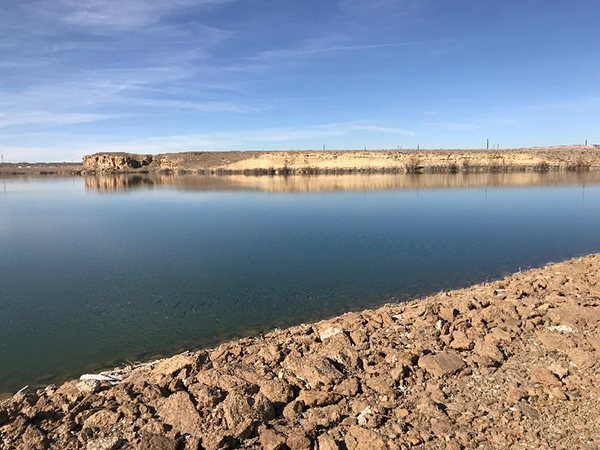 |
| Existing San Juan Generating Station Raw Water Storage Reservoir |
San Juan Generating Station Water Infrastructure Use AnalysisBy James Sterling Acree and Dex L. LewisThe Bureau of Reclamation has begun working collaboratively with both the Public Service Company of New Mexico and the City of Farmington Electrical Utility System to conduct an in-depth analysis to determine the feasibility of using the San Juan Generating Station existing water infrastructure facilities for the raw water intake for the NGWSP San Juan Lateral. The water supply facilities, including a diversion dam and water intake structure at the San Juan River, two pumping plants, supply pipeline, and a raw water storage reservoir, are currently owned by PNM and are used to supply cooling water for the SJGS. While PNM is planning to close the power plant in 2022, the City of Farmington is exploring an opportunity to keep the plant open; in which case joint use of the facilities may be possible and will be part of the analysis. Reclamation had previously identified the Hogback Diversion as the location for the San Juan Lateral intake. Key benefits of the SJGS Diversion over the Hogback Diversion include potential construction cost savings, a decrease in long-term operational costs, and a significant improvement in overall Project operability with the reservoir that would enable the river intake to be shut down — while the water treatment plant is kept operating — in the event of a substantial storm runoff event that muddies the river or an upstream contamination incident, such as a mine spill. The analysis will include assessments of the individual facility features, design and cost estimates of necessary facility modifications, reservoir water quality and sediment analysis, and a review of environmental compliance requirements, cultural resource sensitivities, rights-of-way considerations, and schedule impacts. The analysis is scheduled to be completed by the end of 2020, at which point a decision will be made whether to use the SJGS facilities or stay with the Hogback intake location. |
|
from the |
 |
| Many of these steel face-plates on the upstream side of El Vado Dam will be covered with a grayish membrane as part of the Safety of Dams repairs planned for the dam. |
Albuquerque Area Office Projects Draw Big Public InterestBy Mary CarlsonA couple of Bureau of Reclamation projects have drawn large crowds at public meetings in recent months as area residents try to determine how the projects may impact their lives and communities. Two public meetings were held in Taos, New Mexico on October 21 and 22 as part of the scoping process for the programmatic environmental assessment to analyze the effects of implementing the Taos Indian Water Rights Settlement Mutual Benefit Projects. This analysis is examining the effects of project construction and operation. Under the settlement, Reclamation is designated to distribute funding for the various projects the settlement parties are to construct. Reclamation must do environmental analysis under the National Environmental Policy Act when funding a project.  Members of a group that identify as Guardians of Taos Water participated in a drumming ceremony before a Taos public meeting. More than 100 members of the public attended the two public meetings. Many voiced concerns over the settlement itself and questions on how the environmental impacts would be assessed. The draft Environmental Assessment is currently in the works. The Taos Pueblo Water Rights Settlement Agreement was developed through multi-party negotiations begun in 1989 between Taos Pueblo, the State of New Mexico, the Taos Valley Acequia Association (and its 55-member acequias), the Town of Taos, El Prado Water and Sanitation District, and the 12 Taos-area Mutual Domestic Water Consumer Associations to settle Taos Pueblo’s water rights claims. In December Reclamation hosted two public meetings in Albuquerque and Tierra Amarilla, New Mexico on the draft environmental assessment for safety of dams repairs at El Vado Dam. The work to repair the steel-faced dam to help stop seepage and replace the dam’s spillway is currently planned to begin in 2022. The extensive studies of the dam and the plans for the work are occurring under Reclamation’s Safety of Dams program. The Albuquerque Area Office has also enlisted the help of the Provo Area Office due to its extensive experience working on Safety of Dam Construction Projects. Provo is currently managing the NEPA process. The comment period for the draft environmental assessment closed in early January. The dam located on the Rio Chama in Northern New Mexico stores irrigation water for Reclamation’s Middle Rio Grande Project – which provides water to the Middle Rio Grande Conservancy District and six Middle Rio Grande Pueblos. Current plans for repairs include installation of a geo-membrane over part of the existing steel face of the dam, adding a left abutment seepage blanket and replacing the spillway with a concrete spillway of similar dimensions. The Albuquerque Area Office is coordinating with stakeholders on water management and movement during the construction in hopes of as little disruption as possible. Reclamation expects to be able to by-pass water from the San Juan-Chama Project to its beneficiaries during the construction. |
|
from the |
 |
| Water Management Group from Left: Nathaniel Todea, Mark Delorey, Heather Patno, Rick Clayton, Beau Uriona and Paul Davidson. |
Regional Engineering/Hydrology – a New Team in a New OfficeBy Paul DavidsonReclamation manages water and power by scheduling releases out of our dams and reservoirs. Quite a bit of work goes into this effort, including working with forecasters to determine inflows, modeling outcomes, working with water users to develop water release volumes and close coordination with power marketing agencies such as Western Area Power Administration to schedule daily power generation at our power plants to meet the demands on the western power grid. While each reservoir facility is operated under Record of Decision as part of the Endangered Species Act to assist in the recovery of endangered species. In the Upper Colorado Basin Region, primary responsibility for scheduling releases on Colorado River Storage Project facilities falls to a group of hydraulic engineers in the Water Management Group. A key component to the success of the Water Management Group is working closely with other engineers and hydrologists in the Area Offices, including Provo, Western Colorado and Albuquerque, as well as with the Resources Management Division and the Regional Director’s Office. They also coordinate with numerous outside agencies on environmental and logistical requirements that are part of managing any major river system in the U.S.  Lake Powell storage chart in the new HydroData. The new HydroData portal will allow users to visualize and download over 700 datatypes and compare any year in the record to another using a map based interactive interface. Until recently, these engineers worked in the Water Resources Group within the Resources Management Division, but in 2018 management transferred the team to the Power Office within the new Water and Power Services Division. To avoid confusion, the team’s group changed its name to the Water Management Group. Along with a change in venue, during this past year the team picked up several new team members, including Nathaniel Todea, Beau Uriona and Mark Delorey, joining the established team including Rick Clayton and Heather Patno, under the supervision of Paul Davidson. Area’s of responsibility for each team member is as follows:
During this past year the group have been working on a wide range of activities, which include:
The Power Office is located on the third floor of the Federal Building in Salt Lake City in room 3003 if you are interested in stopping by and saying hello, we are always glad to talk about what we do and answer questions. |
Commissioner Burman's Message on New LogoThe Bureau of Reclamation is modernizing our visual identity, including the logo, as part of a proactive effort to better articulate the important work we do. The new visual identity and logo improves accessibility, is more suitable for digital communications, and can be more uniquely and directly associated with Reclamation. |


Interior Region 7 • Upper Colorado Basin 125 South State Street, Room 8100 Salt Lake City, Utah 84138-1147 If you would like to subscribe or unsubscribe to this newsletter, please send an email with your first and last name to ucbpao@usbr.gov. |