 |
|
UC Today is the quarterly newsletter of the Bureau of Reclamation’s Upper Colorado Basin Region covering the states of Colorado, New Mexico, Utah and Wyoming. We look forward to sharing with you some of the projects and activities that we have been working on to manage, develop and protect water and related resources in an environmentally and economically sound manner in the interest of the American public. January 2022 |
|||
| Office of the Regional Director | Upper Colorado Basin Region Office | Albuquerque Area Office Power Office | Western Colorado Area Office | Four Corners Construction Office |
|||
|
from the |
New Year Note from Regional DirectorBy Wayne Pullan, Regional Director During our last regional all-employees session, I highlighted four key challenges facing our region. I noted that any one of these, by itself, would be enough to challenge and engage the region for a couple of years. But we are facing all four at once. They are:
The question of how we are going to get it all done—while facing a variety of other issues and doing our regular work—is daunting. I had a powerful insight that I wanted to share with you. At the Colorado River Water Users Association meeting, several of us were able to be together. As we dispersed one evening, I was impressed with the capability, experience, diligence, and integrity of that group. In that moment, I had this perspective: "This team has the ability to address our challenges; the nation could not be better served than by having this group on the case." It also came to me that what is true of that small group is true of the whole region. We have the team to address our challenges. The nation could not be better served than by having the Upper Colorado Basin Region on the case. I have known this all along, but on that night it came to me again in a powerful and reassuring way. Last month, I completed my first year as regional director. Thank you for making it a remarkable and memorable year. Thank you for your extraordinary efforts in 2021. Here's to working together in 2022. wgp |
|
from the |
Reclamation modifies monthly water releases from Lake Powell to protect reservoir's elevationBy Upper Colorado Basin Public AffairsThe Bureau of Reclamation began monthly operational adjustments at Glen Canyon Dam on Jan. 1, taking initial steps to protect the reservoir's target elevation of 3,525 feet. As of Jan. 24, Lake Powell's water surface elevation measured 3,532.85 feet, less than 8 feet above the target elevation, which was created to provide a sufficient buffer to take actions to prevent the reservoir from dropping below the minimum power pool elevation of 3,490 feet, the lowest elevation that Glen Canyon Dam can generate hydropower. Without the changes to monthly water releases, the reservoir's elevation was projected to steadily decline below the target elevation through the winter months. The adjusted releases are designed to help protect Lake Powell's elevation until spring runoff materializes. "Under the Drought Response Operations Agreement, making these monthly operational adjustments at Glen Canyon Dam is essential to protect Lake Powell from dropping to critically low elevation levels in the weeks and months ahead," said Reclamation's Upper Colorado Basin Regional Director Wayne Pullan. The monthly volume of water released from Glen Canyon Dam is being adjusted to hold back 350 thousand acre-feet (kaf) of water in Lake Powell from January to April when inflow to the reservoir is low. The same amount of water (350 kaf) will then be released to Lake Mead between June and September after the spring runoff occurs. The annual volume of water released from Glen Canyon Dam is unchanged by these operational adjustments. The modified release pattern for Glen Canyon Dam is as follows: 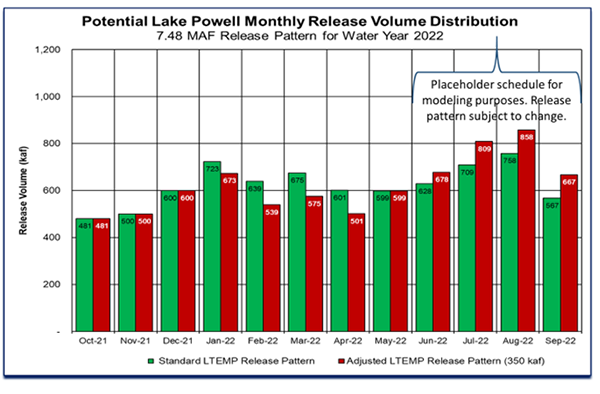 The modified release pattern was put into action after Reclamation met with basin partners including the basin states, Tribes, federal agencies, non-governmental organizations and water managers to discuss the purpose and need to shift the delivery schedule of water. The modified release pattern may be further adjusted, if needed, in response to changing hydrologic conditions. The operational adjustments are consistent with the dam's Long-term Experimental and Management Plan Record of Decision (LTEMP ROD) and will not impact operating tiers or annual release volumes at Lake Powell or Lake Mead. Only the monthly volumes are being adjusted; the annual release volume of 7.48 million acre-feet for water year 2022 (October 1, 2021 – September 30, 2022) will remain the same. If future projections indicate the monthly adjustments are insufficient to protect Lake Powell's elevation, Reclamation will again consider additional water releases from the Colorado River Storage Project initial units of Flaming Gorge, Blue Mesa and Navajo reservoirs. Meanwhile, Reclamation and the Upper Basin states continue to work on a Drought Response Operations Plan and expect to have it completed in April 2022. An electronic copy of the draft Drought Response Operations Plan (framework and attachments) can be found on our website. |
|
from the |
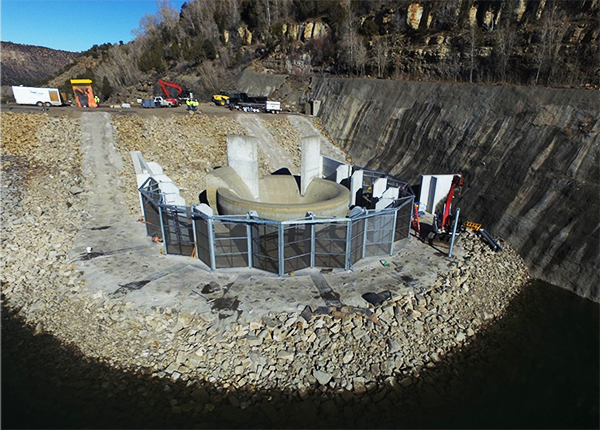 |
| The fish screen is installed around the spillway at Ridgway Reservoir. Photo by Kyle Kissner, Kissner G.C., Inc. |
Ridgway Fish ScreenBy Matt Bryner, Western Colorado Area OfficeConstruction of the Ridgway Fish Screen at Ridgway Reservoir in Montrose County, Colo. will be completed in spring 2022. The fish screen is being constructed to prevent invasive small mouth bass from being introduced to downstream waterways and harming endangered and native fish populations. Small mouth bass are stocked in Ridgway Reservoir as a sport fish. Since 2012, Tri-County Water Conservancy District has kept Ridgway Reservoir at a lower elevation to prevent water from spilling over the morning glory spillway, which is basically a large drain where small mouth bass can escape and make their way to the river. Small mouth bass are a shallow water species that live in the upper part of the reservoir and do not swim deep enough to be released through the normal outlet works found near the bottom of the reservoir. 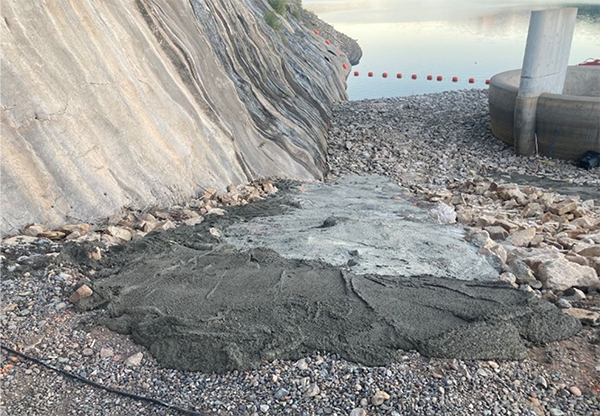 With the construction of the new fish screen, water users will be able to use the full volume of the reservoir and water can spill over the morning glory spillway during high runoff. The rigid screen structure being built around the morning glory spillway will prevent any fish that cannot fit through a quarter-inch diameter hole from being released during a spill. Fish that are small enough to fit through the screen are not dangerous to the native species downstream because they become food for larger fish. 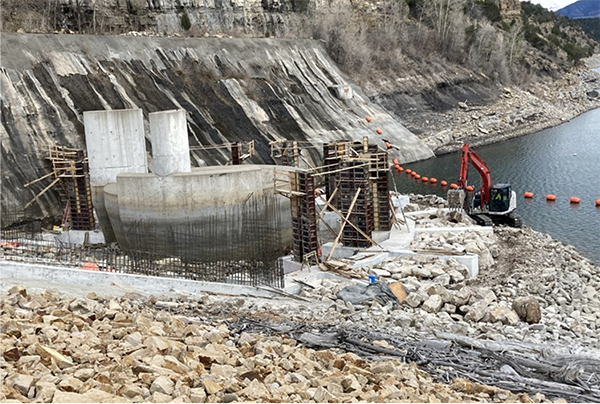 On August 10, 2021, the $1.6 million contract for fish screen construction was awarded to Kissner G.C., Inc. of Cedaredge, Colo. Construction began September 7, 2021, with removal, cleaning, replacement and grouting of riprap for three "access lanes" that went from the top of the dam to the morning glory spillway platform. These lanes supplied a path for equipment during construction and will allow equipment to have access to the screen for maintenance in the future. The prefabricated support structure and screen elements were placed, and work is now focused on the installation of the support structure for the debris boom and the debris boom itself. Similar efforts to prevent invasive fish species from being released through spillways have been implemented at several reservoirs including, Highline Lake, Rifle Gap Reservoir and Elkhead Reservoir. These facilities all use a "floating net" type system. The unique configuration of the "morning glory" style spillway at Ridgway Reservoir allowed the use of a rigid screen structure that is expected to drastically reduce maintenance efforts as the screen will be accessible for cleaning as the water level drops during the water year. Floating nets also must be cleaned by underwater divers and have a relatively short life (approximately 10 years), compared to a 40+ year expected life for the screen structure. |
|
from the |
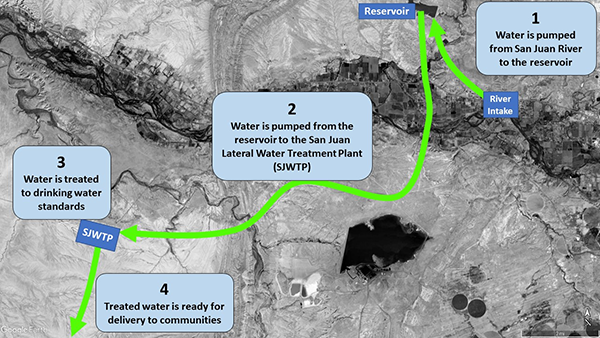 |
| Water for the NGWSP's San Juan Lateral will be drawn from the San Juan River and stored in an existing reservoir prior to treatment and delivery. |
Evaluation of San Juan Generating Station Water Conveyance Facilities In ProgressBy James (Sterling) Acree, Project Management SpecialistReclamation has been analyzing the possible inclusion of the San Juan Generating Station water conveyance facilities into the Navajo-Gallup Water Supply Project, and a draft Environmental Assessment is expected to be released for public comment in the spring of 2022. In 2018, the Public Service Company of New Mexico with plans for closing down the power plant in 2022, approached Reclamation and suggested consideration of incorporating the existing river intake and water conveyance system, including the San Juan Generating Station reservoir, into our water supply project. Since then, Reclamation has learned of the city of Farmington and Enchant Energy's interest in keeping the power plant operating and have confirmed there is sufficient system capacity for both the NGWSP and continued power generation. Use of these existing facilities could provide major benefits to NGWSP, including increased reliability of the water supply, improved and consistent water quality entering the water treatment plant, greater operational flexibility during monsoon events, and both capital and operational cost savings. These benefits come with the system's 50+ years of reliable performance and inclusion of an off-river storage reservoir capable of supplying approximately two weeks of water supply at full-NGWSP demands. Water sampling and testing has begun and will continue to take place at both the San Juan River and the SJGS reservoir. The testing showed that the water in the reservoir is of similar water quality to the river, as it was only used for storage without any return flow from the power plant, and is fit for drinking water treatment. Once treated, this water will meet or exceed Federal Safe Drinking Water Act standards and can be ready for delivery through the NGWSP to Navajo communities and to the city of Gallup by summer 2028. |
|
from the |
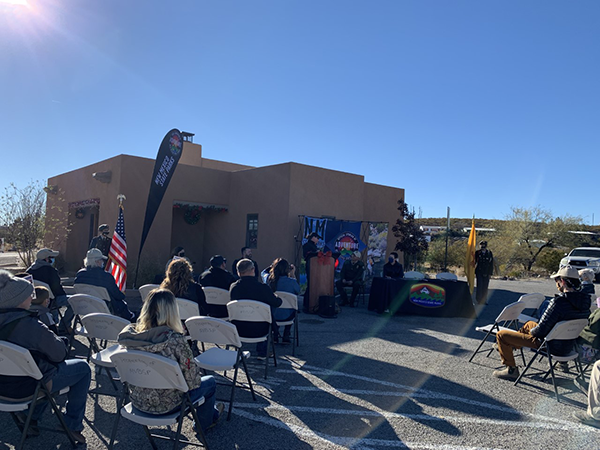 |
| Albuquerque Area Manager Jennifer Faler thanks the state of New Mexico for the continued partnership in managing recreation at Caballo and other Reclamation facilities throughout New Mexico at the dedication of the new visitor center at Caballo Lake State Park. Reclamation photo |
New Caballo Visitor Center UnveiledBy Mary Carlson, Albuquerque Area Public AffairsThe Bureau of Reclamation and New Mexico State Parks are pleased to announce the opening of a new visitor center at Caballo Lake State Park. New Mexico State Parks hosted a dedication and ribbon cutting for the facility on December 11, 2021. The $1.2 million visitor's center, funded by both entities, includes a solar power system providing 8.69 kW of energy and a charging facility for electric vehicles. This charging station will serve travelers along the Interstate-25 corridor and all visitors to the park. "We are excited to see New Mexico State Parks offer more information and amenities for visitors at Caballo Reservoir," said Reclamation's Albuquerque Area Office Manager Jennifer Faler. "Consistent with Reclamation's mission to deliver water in an environmentally friendly manner, we are pleased to see the use of renewable energy here." For more than 50 years, New Mexico State Parks has managed recreation at seven Reclamation reservoirs and two diversion dams under an agreement with Reclamation. "Reclamation continues to value our partnership with New Mexico State Parks and their important role in providing public access for recreation at reservoirs throughout the state," Faler said. |
|
from the |
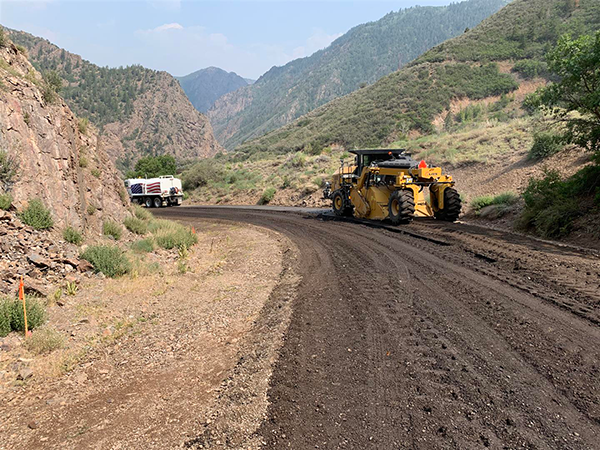 |
| Asphalt Recycling & Stabilization, Inc. milling old asphalt on East Portal Rd. June 2021. Reclamation photo by Grant Watson |
East Portal Road work completeBy Grant Watson, Crystal PowerplantPlans to divert water from the Black Canyon's more dependable Gunnison River were visionary- beginning in 1894, surveys eventually revealed locations for both ends of a tunnel that was to be 11-by-12 feet for six miles. A road was scraped into the canyon slopes with grades up to 32%, descending to the river, and the town of East Portal was born. By 1906, East Portal was a thriving community clutching the slopes of the canyon. While it never housed more than 250 people, it provided bunkhouses and a dining hall for single men working around the clock for three shifts. It also offered private cabins for families and other services including a hospital, post office, general store, library, billiard hall, and school. The tunnel was completed and dedicated in 1909- though much work remained. A diversion dam, concrete lining of the tunnel, and ditch system were not completed until 1922. 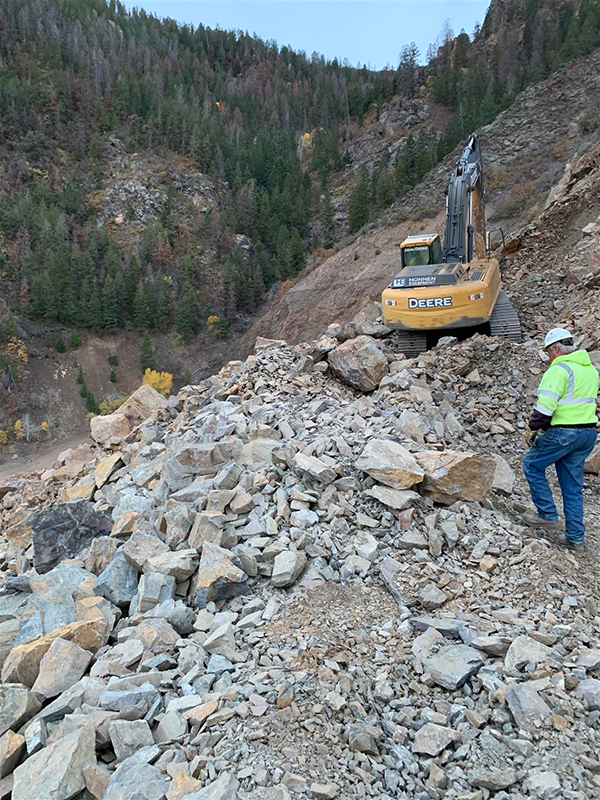 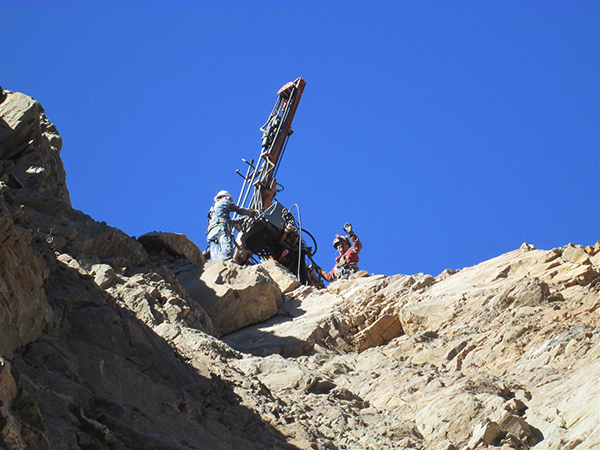 April 11, 1956 construction was authorized for Crystal Dam and Powerplant. First bucket of concrete placed in the dam was on July 31, 1974 with initial power generation starting July 1978. The last time East Portal Road had seen new pavement was in the 70's, until Reclamation partnered with the Federal Highway Administration to make significant improvements to the road surface and rock fall mitigation. Oldcastle SW Group (United Companies) was awarded the bid along with 12 subcontractors as the work began on June 1, 2021. With erosion control in place, 13 of the 54 culverts were cleaned, and four were completely replaced with new inlets, outlets, and riprap. One of the most dangerous rock sections of the road was planned to be removed, and this turned out to be one of the largest challenges of the project. There were 24 separate blasts that normally took 1-3 days to clean up; one extraordinary blast closed the road for five days. 872 pounds of dynamite were used along with 6662 pounds of ANFO (ammonium nitrate/fuel oil) with an estimated amount of rock debris removed at 26,000 cubic yards. Finishing touches included over 2000 tons of road base for shouldering with new center and side striping. The project was ultimately completed December 3, 2021. Many thanks to all that were involved, with special thanks to Jenna Bergstrom and Rex Hall with FHWA. This work will enhance park visitors' experience and improve safety for all that drive on it. 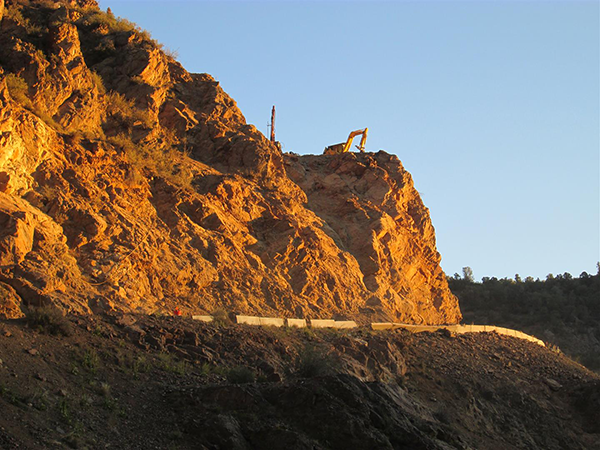 |
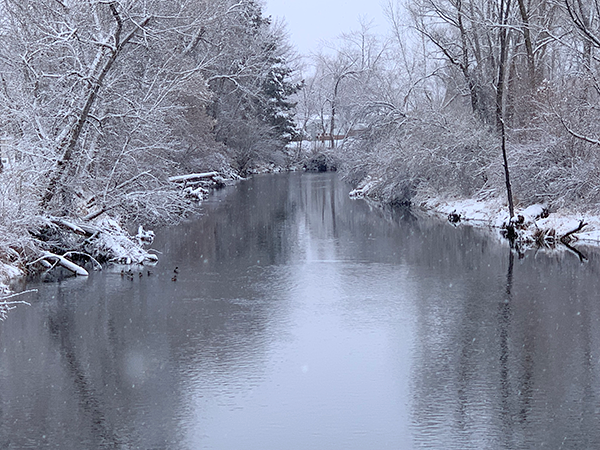 |
| Photo showing snow in 2021 on the Weber River, Utah, during a winter storm. Reclamation photo by Amee Andreason |



Interior Region 7 • Upper Colorado Basin 125 South State Street, Room 8100 Salt Lake City, Utah 84138-1147 If you would like to subscribe or unsubscribe to this newsletter, please send an email with your first and last name to ucbpao@usbr.gov. |